There is a political tradition in Britain of solving problems by creating worse ones. Nowhere is this more perfectly illustrated than in what happened to the British pub after 1989.
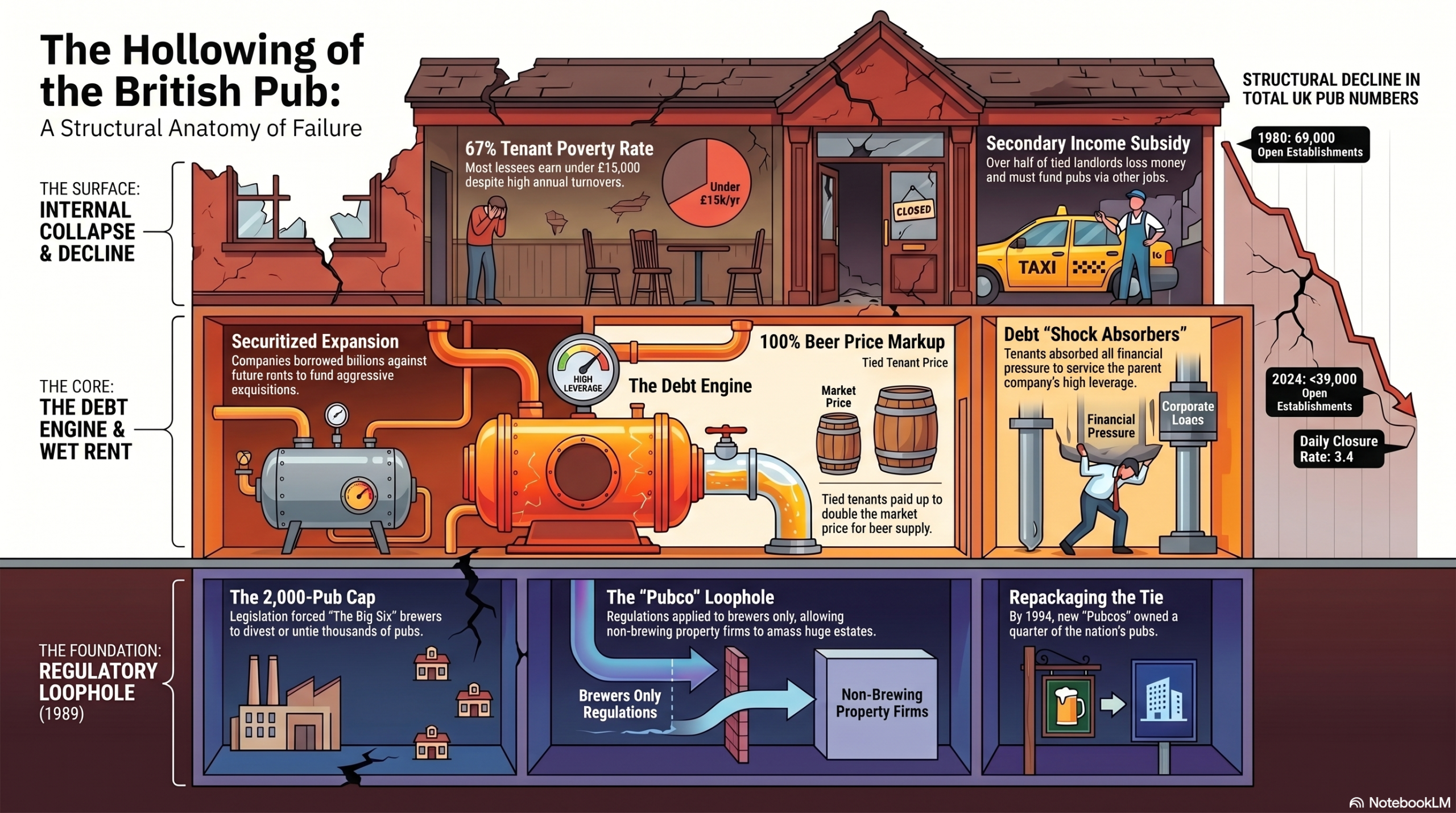
The three layers of decline: regulatory loophole, debt engine, human cost. The cliff on the right is not a culture. It’s architecture.
Running this problem at your pub?
Here's the system I use at The Teal Farm to fix it — real-time labour %, cash position, and VAT liability in one dashboard. 30-minute setup. £97 once, no monthly fees.
Get Pub Command Centre — £97 →No monthly fees. 30-day money-back guarantee. Built by a working pub landlord.
The story begins with a finding that nobody seriously disputed: Britain’s brewing industry was a cartel. The Big Six Allied Breweries, Bass, Courage, Grand Metropolitan, Scottish & Newcastle, and Whitbread had amassed a stranglehold over the beer market. They either owned the majority of pubs in their areas outright or had sole rights to sell their beer to pubs through tied leases. Beloved local brands were actually subsidiaries of these giants, and most drinkers had no idea. Vittles
Between 1966 and 1986, the brewing industry was the subject of no fewer than 15 official reports. In 1969, the Monopolies Commission had already concluded that the tie was anti-competitive. And yet nothing changed. The brewers were too powerful, too embedded, too comfortable. Protzonbeer
Then came Margaret Thatcher — and Lord Young.
The Report That Was Going To Fix Everything
The Beer Orders followed a Monopolies & Mergers Commission inquiry that found the industry was a “complex monopoly” and recommended that brewery-tied estates be capped at 2,000 pubs. When the report landed in March 1989, Lord Young declared he was “minded to implement the recommendations.” The following months, his aide later said, are “burned into my memory.” Morning AdvertiserMorning Advertiser
They should be burned into all of ours.
Lord Young’s Beer Orders were a compromise that paid lip service to the MMC without adopting its more radical demands. From 1 May 1990, the Big Six were given two years to remove the tie completely from half their pubs over the first 2,000 each owned — a total of around 11,000 pubs — while the rest had to allow a “guest beer.” Protzonbeer
The Brewers Society, unsurprisingly, called the initial proposals “a charter for chaos.” A lone dissenter on the MMC, trade union representative Leif Mills, described the forced sell-off as “an unnecessary leap in the dark” that might very well make matters worse. Morning Advertiser
Mills was right. Spectacularly right. The government simply didn’t listen.
The Unintended Consequence That Was Entirely Predictable
Here is what the legislation didn’t account for: it was written specifically to restrict brewers. It said nothing about companies that owned pubs but didn’t make beer.
Rather than creating a free market of independent publicans, the Beer Orders triggered a mass sell-off into the hands of pub-owning companies: pubcos. Punch Taverns, Enterprise Inns, Admiral Taverns. These were not brewers. They did not make beer, market beer, or care about beer. They owned property. They collected rent. And because they were not brewers, they fell outside the scope of the Beer Orders entirely. The legislation never saw them coming. The Liberty Beacon
At least half of the pubs sold off were bought by independent pubcos set up to take advantage of the sell-off, seeking to make a profit from both rent on the property and the margin they could charge licensees on beer — known as the “wet rent.” Morning Advertiser
By 1994, a quarter of all the country’s pubs were owned by new pubcos. The tie hadn’t been broken. It had been repackaged — and made considerably worse. Protzonbeer
The Debt Engine
What followed was one of the most reckless periods of financial engineering the British hospitality sector has ever seen.
By 2007, one of the largest pubcos, Punch Taverns, owned over 7,000 pubs with debts of over £4 billion. This borrowing had enabled pubcos to expand rapidly during the 1990s. The pubcos then discovered securitisation, borrowing against future rents to fund the acquisition of more pubs. It was a debt engine masquerading as a hospitality business. The ConversationThe Liberty Beacon
Punch acquired its larger rival, Pubmaster, in 2003 for £168 million, including taking on Pubmaster’s £1 billion debt, thereby taking the group to more than 7,000 pubs. Enterprise Inns was doing the same. Both companies were building empires on borrowed money, secured against the pubs and the tenants inside them. Wikipedia
Tenanted pubs, on paper, paid lower rent but were tied into a beer supply contract with the pub company, which could cost up to twice as much as it would through other distributors. The pubco typically generated half of its income from rent and the other half from the beer margin. Despite having strong contracts with suppliers, pubcos would generally pass on the full wholesale price increase to tenants, keeping the difference. CBS News
Why? Quite simply, the largest ones, particularly Punch and Enterprise, were so highly leveraged that they couldn’t afford to. CBS News
The tenants were the shock absorbers for the debt. Every time the model came under pressure, the squeeze went downward.
What This Actually Did to Publicans
A 2009 House of Commons inquiry found that 67% of lessees surveyed earned less than £15,000 a year. Over 50% of lessees with turnover exceeding £500,000 a year still earned less than £15,000, a 3% rate of return. The lessees may share the risks with their pubco, but they do not appear to share the benefits. Wikipedia
Read that again. Running a pub with half a million pounds of turnover and taking home less than fifteen grand a year. The select committee was “astonished.” The rest of us should be furious.
In a 2010 survey by the GMB trade union, over half of tied pub landlords said they lost money from their pubs and had to subsidise them through a secondary income. These weren’t failing operators. These were people working themselves to the bone inside a system designed to extract maximum yield from them, regardless of whether they survived. VICE
The European Commission found that the average differential that tenants were paying per barrel above free-market prices rose from £19 in 1991 to £48 in 1997. Not a transient spike. A structural compounding squeeze built into the contract is enforced by the lease. Morning Advertiser
The Numbers Tell Their Own Story
In 1980, there were 69,000 open drinking establishments in the UK. Looking at figures from 2000 until 2024, there have been 15,800 pub closures — a difference of more than a third. By the end of 2024, the figure fell below 39,000 for the first time. In Q1 of 2026, licensed venues dropped by another 305 — an average of 3.4 closures a day. Statista + 2
This is not a cultural shift. Culture doesn’t produce a consistent, decades-long structural decline that accelerates precisely when financial pressure on pub landlords increases. That’s a system failure. A policy failure. Dressed up, repeatedly, as taste.
The Budget That Finally Made Everyone Pay Attention
In October 2024, Rachel Reeves delivered a budget that the hospitality sector described, with unusual unanimity, as a catastrophe. Employer National Insurance contributions rose by 1.2 percentage points to 15%, with the per-employee threshold at which employers start to pay reduced from £9,100 per year to £5,000 per year. At the same time, the 75% business rates discount for hospitality was reduced to 40%. Hospitality & Catering News
Hospitality leaders wrote to the Chancellor, warning that, alongside changes to the national minimum wage, the budget would cost the hospitality sector a conservative estimate of £3.4 billion a year. The threshold change alone, they estimated, may be four times the cost of the new headline rate. Ukhospitality
The media called it the tipping point. The moment pubs became front-page news. The existential crisis.
But here’s the truth that this article has been building to: this was not a tipping point. It was the latest shove applied to something that has been structurally weakened for thirty-five years.
The Beer Orders of 1989 didn’t kill the British pub. But they created the conditions in which the British pub could be slowly, systematically hollowed out — while successive governments nodded along, described the closures as cultural inevitability, and ignored the evidence in their own select committee reports.
I have spent fifteen years inside this system. I have watched it up close. The question I kept asking — the question we should all have been asking is why a country that genuinely loves its pubs has allowed this to happen.
The answer starts in 1989. And it is not finished yet.
Running your pub on gut feel?
The Pub Command Centre gives you wet GP%, cellar checks, staff cost and weekly P&L — from your phone, every shift. £97 once. No subscription.
See the Pub Command Centre →