Most people have a rough idea of what a pub landlord does.
They pull pints. They manage staff. They deal with Friday night chaos and Sunday lunchtime regulars. They keep the lights on and the cellar cold.
Running this problem at your pub?
Here's the system I use at The Teal Farm to fix it — real-time labour %, cash position, and VAT liability in one dashboard. 30-minute setup. £97 once, no monthly fees.
Get Pub Command Centre — £97 →No monthly fees. 30-day money-back guarantee. Built by a working pub landlord.
What most people don’t realise is what the landlord signs before any of that begins. The contract beneath the British pub, the lease, tenancy, retail agreement, or franchise, is one of the most consequential documents a small business owner will ever put their name to.
There are now more agreement types than ever. Some are fairer than others. And the differences between them are enormous.
I have spent 15 years in this system and am currently operating under a Marston’s Community Retail Partnership. This is the piece I wish had existed when I started.
The Landscape Has Changed
Before we get into each model, it’s worth understanding why there are now so many different agreement types in the first place.
The traditional tied lease, as we covered in earlier articles in this series, was an instrument that generated enormous financial pressure on operators. The evidence from decades of parliamentary inquiries made that clear. In response, the larger pub companies have gradually developed alternative models. Some represent genuine innovation. Some are the same economics in a different suit.
Understanding the difference is the whole game.
There are currently five main agreement types in operation across the British pub sector. They are fundamentally different in structure, risk, and earnings potential. However, most people entering the sector have only ever heard of two of them.
Agreement Type One: The Traditional Tied Tenancy
A tenancy is a short-term agreement, typically two to five years. It is the traditional entry point into the pub trade.
The attraction is relatively low entry cost. Experienced operators and newcomers alike can get into pub operating for a fraction of what a freehold would cost. Banks are reluctant to lend to inexperienced operators, so re-mortgaging or selling personal assets to fund a tied ingoing is often the only realistic route in. Morning Advertiser
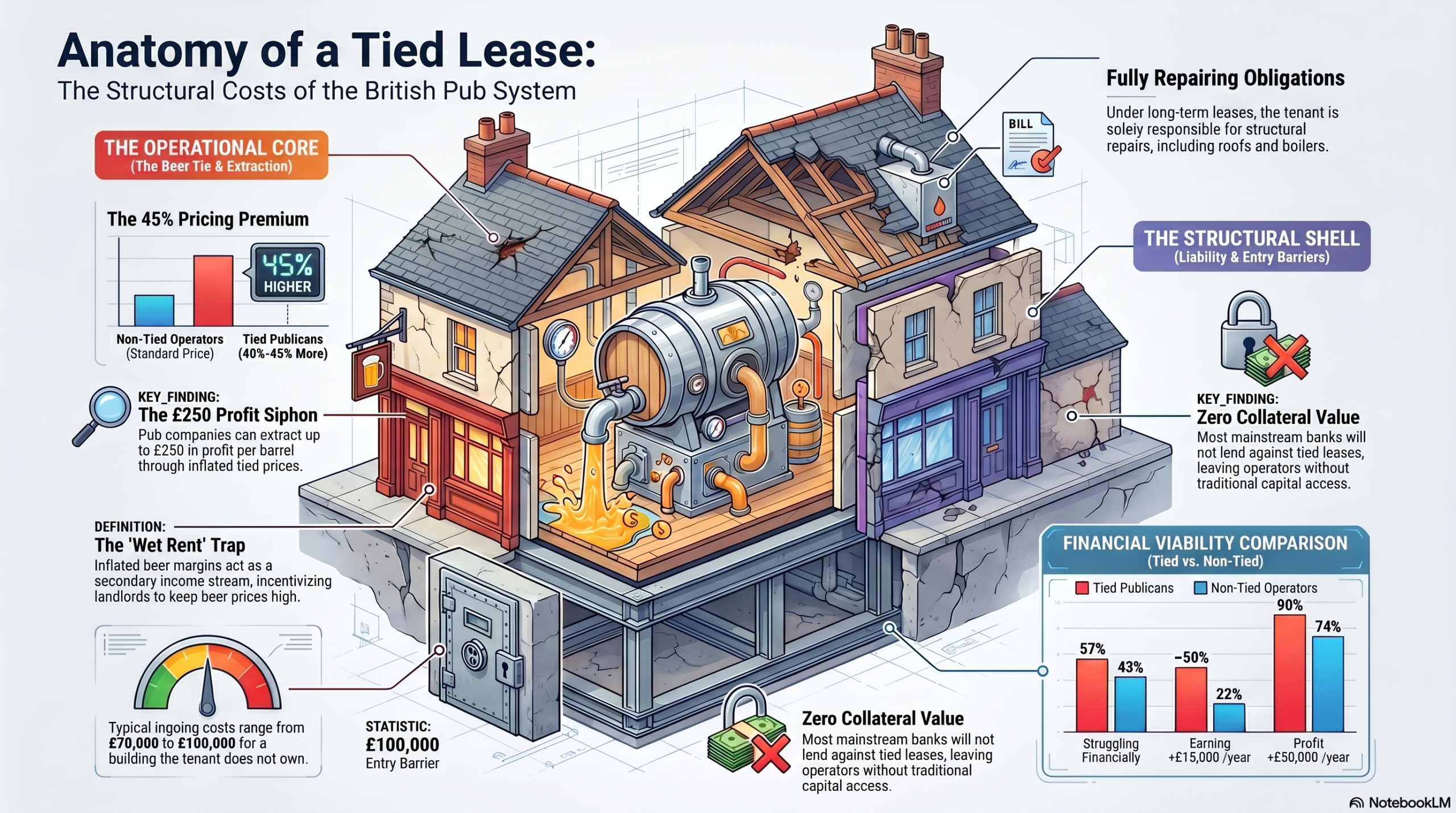
However, the costs are more significant than they first appear. For a Greene King tenancy, the minimum entry investment is £20,000, covering fixtures and fittings and a tenant deposit. For larger, more established sites, ingoing costs can be considerably higher. Shorthandstories
The core terms are straightforward and constraining. Under a tenancy, you must get your supply of beer from the landlord. This is the beer tie. Pub companies can tell if you have been buying from elsewhere through flow meters on your beer lines. The consequences of breaking the tie are serious. Businessdebtline
Furthermore, you cannot sell the business on when you leave. With a tenancy, there is no guarantee at renewal. You can build a business up and then be out. The pubco can say the tenancy is ending, double the rent, and you either accept it or you don’t. Morning Advertiser
Critically, tied leases are agreements that banks will not lend against. The tied lease has no recognised collateral value. So when you need capital for improvements or to weather a difficult period, you are on your own. Dootsons Solicitors
Agreement Type Two: The Tied Lease
A lease is the longer-term version, typically ten to twenty-five years. It is the agreement for operators with experience and a long-term view on a specific site.
Greene King’s fully repairing and insuring lease runs for 10 to 25 years and is protected under the Landlord and Tenant Act 1954, with rights of renewal. It is subject to five-yearly open market rent reviews and annual RPI, which is capped. You can sell the agreement after two years. Greenekingpubs
The ability to sell on goodwill is the key advantage over a tenancy. However, the obligations are considerably heavier. A fully repairing and insuring lease means every repair, every structural issue, every dilapidation, that is your financial responsibility. On a building you do not own.
The rent review process is where much of the structural imbalance lies. Rent is calculated on Fair Maintainable Trade, which is what a reasonable operator should be able to earn from the pub. Overestimating gross profit by just 1%, or underestimating costs by the same, can have almost a 10% reduction in total earnings. The margin for error is extremely thin. Pubs
Meanwhile the beer price gap remains throughout the lease. Tied publicans pay between 40 and 45% more for their beer than independent operators. That premium applies every single week, for the full duration of the agreement. yorkshirepost
Agreement Type Three: The Retail Agreement
This is the model that has grown significantly in recent years and remains poorly understood outside the sector. It is fundamentally different from a tied lease or tenancy, and it matters.
Under a Marston’s retail agreement, operators pay no rent, and the pubco covers the majority of bills. The pubco provides stock, fixtures and fittings, and till systems. The operator’s income is based on a percentage of the pub’s weekly sales. Marstonscareers
That is a radically different risk and reward structure. The pubco owns the commercial risk on costs. The operator earns from performance, not from navigating a complex cost structure.
The retail agreement model allows the operator to retain a percentage of revenue and take responsibility for staff employment. All other costs are paid by the pubco. The Caterer
However, the percentage matters enormously. Early versions of the Marston’s retail agreement paid operators approximately 20% of net takings each week. For a community pub with modest turnover, that percentage needs careful modelling against staffing costs, which remain the operator’s responsibility — before any income is realised. AccountingWEB
The Marston’s Partnership now accounts for more than two-thirds of the company’s estate, around 900 pubs, and the current agreement runs for five years with a three-month notice period. That short notice period cuts both ways. It gives the operator flexibility to leave. It also means Marston’s can exit the relationship relatively quickly. Morning Advertiser
The newer Marston’s model has evolved further still. The updated Partnership deal offers no rental costs, with the relationship run on a shared-turnover basis across wet, dry, and accommodation streams. Marston covers all fixtures, fittings, and building maintenance, offering operators a turnkey solution. Morning Advertiser
That is a meaningful departure from the traditional tied lease model. The question — and it is a genuine one — is whether the percentage share of turnover adequately compensates for the labour cost exposure and the loss of ownership of business assets.
I operate under this model at Teal Farm. My honest assessment: it removes the most punishing elements of the tied lease, the rent review risk, the beer price markup, and the capital exposure on repairs. However, it also means you are building someone else’s asset. You will not leave with goodwill to sell. Your income is entirely performance-dependent, with staffing costs sitting between you and any meaningful earnings.
For the right operator in the right pub, it works. It is not, however, the same as running your own business in the full commercial sense.
Agreement Type Four: The Turnover-Based Partnership Agreement
Greene King has developed a similar model to the Marston’s retail agreement, structured as a turnover-based partnership.
The Greene King partnership agreement is a five-year fixed-term, 100% turnover-based agreement, contracted out of the Landlord and Tenant Act 1954. The rent is calculated as a percentage of weekly turnover, with a cap and collar applying. Greene King is responsible for the structure of the building. Greenekingpubs
The cap-and-collar mechanism is important. It means the operator’s payment to Greene King has a minimum and a maximum, regardless of trading performance. This protects the pubco’s income floor during weak trading periods and limits the operator’s upside during strong ones.
This model sits between a traditional tenancy and a retail agreement in terms of risk transfer. The operator has more independence than under a retail agreement. However, they do not have the full cost coverage that Marston’s provides.
Agreement Type Five: The Franchise Model
The newest and most accessible entry point into pub operating is the franchise agreement. Both Marston’s and Greene King now offer franchise models, and they represent a genuinely different proposition from everything above.
Under a Greene King franchise, the company provides the property, all stock and products, a preset menu, and investment of up to £400,000 in the physical premises. The operator earns a guaranteed minimum income plus a share of turnover and profit-related bonuses. There is no rent to pay. Smartpubtools
The minimum guaranteed annual income is £20,000, with additional income from a percentage of weekly turnover, a quarterly profit share, and the ability to earn bonuses by meeting compliance audits. The ingoing cost is £5,000. Greene King
That ingoing cost — £5,000 against up to £100,000 for a traditional tied lease — makes the franchise the lowest-risk entry into pub operating that has ever existed in the British pub trade.
However, the trade-offs are real. You have no commercial independence. The menu is set. The offer is defined. The pubco audits your compliance. You are, in meaningful terms, running a branch of someone else’s brand, not your own pub business.
For Greene King’s Nest franchise, operators receive a 20% share of net turnover paid weekly, plus an annual bonus scheme of up to £5,000. For operators whose primary goal is a stable income with low capital risk, that may be exactly right. For operators who want to build something, it is a ceiling rather than a floor. Shorthandstories
The Comparison That Matters
Here is how the five models sit against each other on the dimensions that most affect operator outcomes:
Risk to personal capital: Tied lease highest, franchise lowest. Retail agreement sits in the middle — low capital risk, but staffing cost exposure.
Income potential: Tied lease with strong trading has the highest ceiling. Franchise has the lowest ceiling but a guaranteed floor. Retail agreement depends entirely on the percentage and the pub’s turnover.
Asset ownership: Only the tied lease (assignable) gives you something to sell. Tenancies, retail agreements, and franchises leave you with nothing when you go.
Commercial independence: Freehold is the only full independence. Tied lease gives partial independence. Retail agreement and franchise give very limited independence.
Beer price disadvantage: Only in the tied lease and tenancy. Retail agreements and franchises eliminate the beer price gap entirely — because the stock is the pubco’s problem, not yours.
What This Means for the Existential Crisis
The proliferation of alternative agreement types tells its own story.
The traditional tied lease model was generating outcomes that were documented in parliamentary inquiry after parliamentary inquiry and were unsustainable for operators. The pubcos, facing the choice between statutory reform and voluntary evolution, have largely chosen the latter.
The retail agreement and franchise models shift financial risk in ways that benefit operators in certain respects. However, they also firmly concentrate on the commercial upside with the pubco. The operator provides labour, management, and community engagement. The pubco retains the asset, the brand, and the income stream.
It is a different model. Whether it is a fairer one depends entirely on what percentage you negotiate, what pub you take on, and how honestly you model the staffing costs before you sign.
What it is not — and this matters — is the solution to the structural problem this series has been documenting. The tied lease broke thousands of operators over thirty years. The retail agreement removes some of those mechanisms. However, it replaces asset-building with income dependency. The operator remains a tenant of someone else’s estate.
The British pub will not be saved by better agreement structures alone. But understanding every agreement type, including those that have emerged since the old model began to fail, is the foundation for making an informed decision about entering this industry.
Signing anything without that understanding is still, in 2026, exactly as dangerous as it ever was.
Running your pub on gut feel?
The Pub Command Centre gives you wet GP%, cellar checks, staff cost and weekly P&L — from your phone, every shift. £97 once. No subscription.
See the Pub Command Centre →