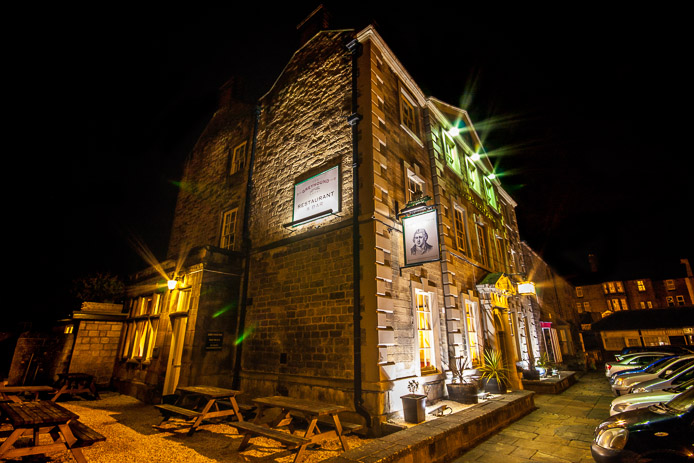
Greyhound Hotel, Cromford — SmartPubTools Pub Opportunity Review
QUICK VERDICT
| Type | Historic hotel-pub-restaurant with eight letting rooms |
| Pubco | Admiral Taverns (traditional tenancy) |
| Best suited to | Highly experienced hotel and food operator with proven multi-faceted business track record |
| Estimated ingoing | £20,000–£40,000 (hotel + food operation — substantially higher than standard pub entry) |
| Trade character | Food-led / hotel / destination |
| Shaun’s rating | ★★★★★ |
| Red flag | This pub is currently closed. It’s not a going concern — it’s a relaunch. Everything you’d inherit from a trading pub (customer base, staff, rhythm, goodwill) you have to build from scratch in one of Derbyshire’s most prominent listed buildings. The opportunity is real, but so is the risk. |
THE LOCAL PICTURE
Cromford is a village of approximately 1,500 people on the River Derwent in the Derbyshire Dales, 17 miles north of Derby and 2 miles south of Matlock. What distinguishes Cromford globally — not regionally, globally — is that it is part of the Derwent Valley Mills UNESCO World Heritage Site, centred on Sir Richard Arkwright’s Cromford Mill (1771), the world’s first successful water-powered cotton spinning mill.
Running this problem at your pub?
This independent assessment was prepared by SmartPubTools using the following publicly available sources:
- Pub listing data: Admiral Taverns published listings — availability, agreement type and rent figures sourced directly from the pub company's own website
- Google rating & reviews: Google Places API — ratings and review counts retrieved programmatically from Google Maps data
- Local population & demographics: ONS Census 2021 — population figures, age profiles and household data
- Local employment data: NOMIS Official Labour Market Statistics — employment rates and major local employer data
- Pubs Code information: Pubs Code Adjudicator (UK Government) — tied tenant rights and MRO entitlements
- Operator perspective: SmartPubTools is operated by a working pub landlord under a Marston's Community Retail Partnership at Teal Farm Pub, Washington NE38 — assessments reflect genuine first-hand operator experience
Here's the system I use at The Teal Farm to fix it — real-time labour %, cash position, and VAT liability in one dashboard. 30-minute setup. £97 once, no monthly fees.
Get Pub Command Centre — £97 →No monthly fees. 30-day money-back guarantee. Built by a working pub landlord.
For a complete overview of the process, read our complete guide to taking on a UK pub in 2026.
Tourism is the dominant commercial driver. The site attracts tens of thousands of visitors annually from across the UK and internationally. Cromford station (7 minutes’ walk) serves the Matlock–Derby line. A direct bus route to Sheffield and Chesterfield runs from outside the pub. The Peak District National Park edge is a 5-minute drive away.
The Greyhound sits directly on Cromford’s Market Place as the most prominent building in the village. It was built in 1778 — Arkwright himself commissioned it. The building has stood for 246 years and has never been less than significant. CAMRA describes it as “the most prominent building in Cromford market place” and notes the “prominent Smith of Derby clock” recently restored on the facade.
No Wetherspoons within meaningful distance.
WHAT THE PUB IS
A Grade II listed three-storey Georgian sandstone building of exceptional character. The pub is well documented: an open-plan bar and dining area, elevated lounge seating, wood-panelled bar, substantial wine offering (70+ in its best trading incarnation), three changing cask beers, and — critically — eight high-quality letting rooms providing an accommodation income stream that most pubs in this series would envy.
The pub has operated successfully as a hotel-restaurant and has strong Tripadvisor history when trading. Reviews reference scallops, ribeye, rice pudding with raisin and cardamom ice cream — this is not a standard pub food operation. The previous commercial identity was sophisticated and quality-led.
Admiral’s listing is explicit: this is not currently trading. They describe it as an opportunity to “unlock its full potential” and state a “strong support network along with a competitive financial package” will be provided for the right operator.
THE ADMIRAL TAVERNS DEAL
Standard Admiral tenancy structure, but given the complexity of this site (listed building, hotel operation, kitchen), the terms are likely to be more tailored than a standard wet-led community pub. All drinks categories tied. Service charge £65.86/week. Zero business rates (draft April 2026 rating list, qualifying conditions). Pre-entry training: 7 Steps to Sales Success (£350).
Admiral’s listing is clear about what they want: “an experienced licensee or couple with a proven track record of running a successful, multi-faceted business… strong background in food-led operations is essential, along with ideally experience in managing letting rooms.”
This is not a community boozer opportunity dressed up in Georgian sandstone. It is a serious commercial challenge requiring serious commercial experience.
FINANCIAL REALITY
| Metric | Estimate |
|---|---|
| Ingoing (stock + F&F + pre-opening costs) | £20,000–£40,000 |
| Annual rent (full tie) | £24,000–£38,000 estimated (listed destination hotel) |
| Weekly rent | £462–£731 |
| Working capital | £25,000–£40,000 minimum |
| Service charge | ~£65.86/week |
| Letting room income potential | £8 rooms × £60–£100/night × occupancy |
| Business rates | £0 (qualifying conditions) |
| Break-even timeline | 24–36 months for a relaunch of this complexity |
Eight letting rooms at even 50% occupancy at £75/night generates approximately £109,500 per annum in additional revenue outside the pub operation — meaningful, but only if rooms are maintained, marketed, and managed properly.
PUBS CODE RIGHTS BOX
✅ Independent rent assessment — essential; a Grade II listed hotel pub commands a significant premium and the independent assessment is your protection
✅ MRO option — with an accommodation income stream, the free-of-tie comparison may be substantial
✅ P&L projections from Admiral for both pub and hotel streams separately
✅ Schedule of Condition — a listed building that is currently closed needs a thorough survey; historic buildings accumulate maintenance obligations quickly
✅ Tied product price list in writing
✅ Pre-entry training (£350)
WHO THIS SUITS
A couple with demonstrable hotel and food experience — not pub management experience, hotel experience. You need to understand room pricing, channel management (Booking.com, direct), housekeeping operations, and breakfast service, as well as running a quality food pub. Marketing skill is essential: the Greyhound needs relaunching and the Peak District / UNESCO tourism market requires active online presence.
If your background is purely wet-led community pubs, this is not your next step. If you have successfully run a small hotel or gastro-pub hotel, this is one of the most distinctive opportunities in England.
WHAT WORKS / WHAT DOESN’T
Works:
– UNESCO World Heritage Site location is a category unto itself for tourism
– Most prominent building on Cromford Market Place — organic footfall from every visitor to the village
– Eight letting rooms create a second substantial income stream
– Cromford station 7 minutes’ walk; direct buses to Sheffield and Chesterfield
– Peak District tourist season extends through spring, summer, and autumn
– Adjacent to Cromford Mill visitor centre — potentially thousands of visitors daily in peak season
– Strong previous commercial identity and Tripadvisor history to build on
– Grade II Georgian sandstone building commands premium pricing when delivered correctly
Doesn’t work:
– Currently closed — no goodwill, no customer base, no staff to inherit
– Listed building maintenance obligations are significant and ongoing
– Multi-faceted operation (pub + restaurant + hotel) requires genuinely multi-skilled operator
– Off-season (November–January) Derwent Valley trade drops sharply — cash reserves are critical
– Full tie on a destination dining pub is a meaningful margin constraint on premium food
– The building’s history creates customer expectation that is unforgiving of mediocrity
WHAT YOU NEED ON DAY ONE
A full Property Management System for the hotel rooms (Little Hotelier or Clock PMS are practical for this scale) integrated with Booking.com and your own website. A kitchen EPOS with table management — Tevalis or Lightspeed Restaurant at minimum. A professional photographer for the hotel before you launch online bookings. Appoint a conservation architect for a pre-signing condition survey — Admiral will have one, but you need your own. Working capital of £40,000 before you put a key in the door. This is the most capital-intensive opportunity in this series by a significant margin.
Before you sign anything, know your numbers. Pub Command Centre gives you real-time labour %, VAT and cash position from day one. £97 once.
https://smartpubtools.com/5684-2/
Running your pub on gut feel?
The Pub Command Centre gives you wet GP%, cellar checks, staff cost and weekly P&L — from your phone, every shift. £97 once. No subscription.
See the Pub Command Centre →