Ask any landlord in the UK how often they clean their beer lines, and they will chant the same mantra: “Every seven days. Same time, same day. Religiously.”
They say it with pride. They shouldn’t.
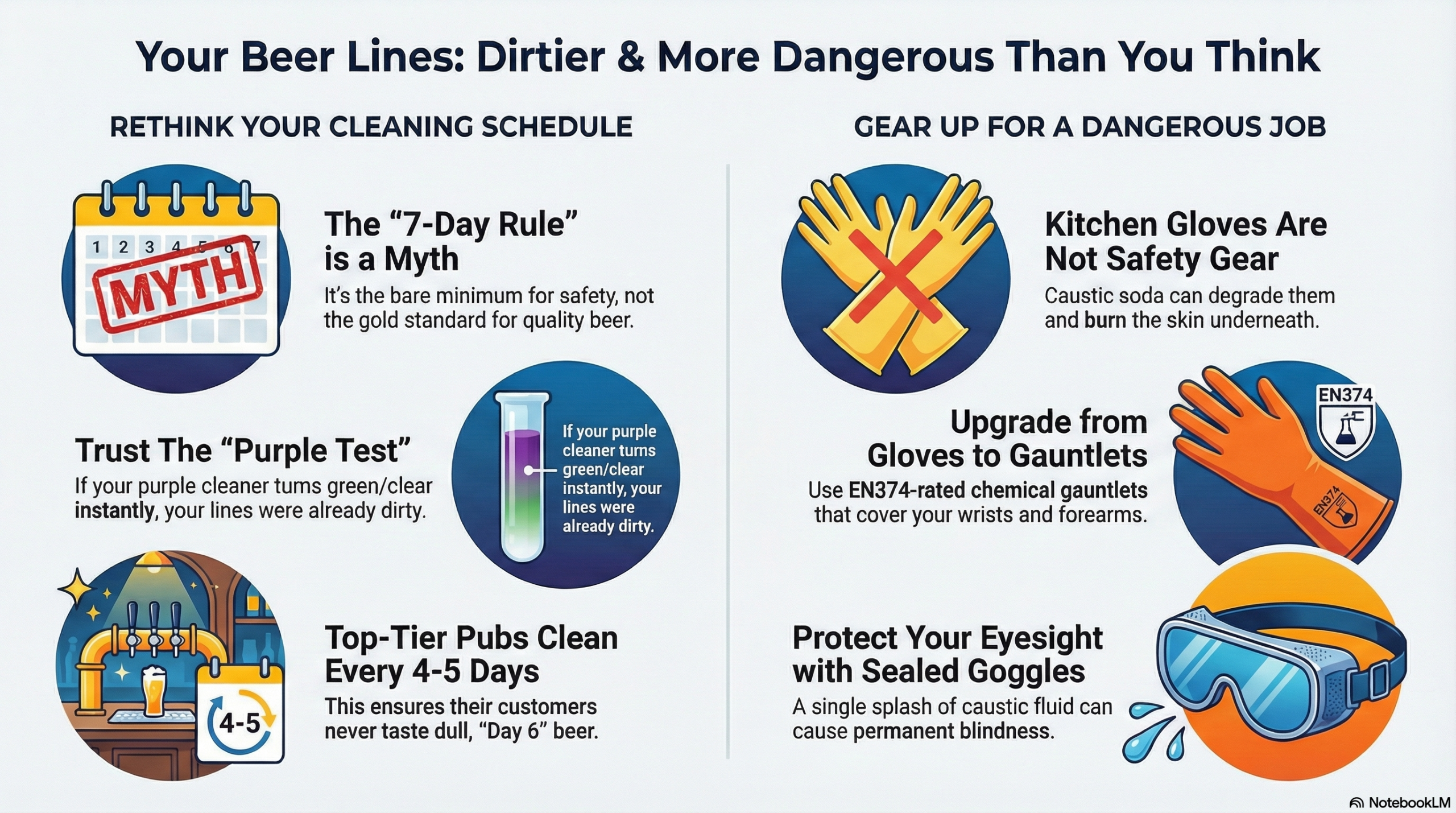
The “7-Day Rule” is not a gold standard of excellence. It is the absolute bare minimum required to stop your customers from getting sick. If you are treating day seven as your “target,” you are likely serving subpar beer on days five and six.
Here is the biological reality of what is happening in your cellar, and why you need to rethink your schedule—and your safety gear.
SmartPubTools
Cellar Operations Audit
Speaking of Good Trades…
You trade your time for money every Sunday. Make sure you aren’t wasting it on food that ends up in the bin. Our tool predicts your sales volume so you only cook what you sell.
Get the Sunday Roast Forecaster© 2025 SmartPubTools. Safety First. Excellence Always.
The Biology: The “Exponential” Problem
Yeast is a fungus. It doesn’t grow in a straight line; it grows exponentially.
- Day 1-3: The lines are clean. The beer tastes crisp.
- Day 4-5: Microscopic colonies of wild yeast begin to attach to the python walls. You can’t taste it yet, but the “crispness” dulls.
- Day 6: The colonies bloom. The beer might not taste “off,” but it loses its sparkle. The head retention drops.
- Day 7: The colony is now a Biofilm. This is when you clean.
By waiting until Day 7, you are allowing the enemy to build a fortress before you attack.
The “Category of One” Approach: Top-tier operators (the ones charging £6+ a pint) often clean every 4 or 5 days for their premium lagers.
- Why? Because they never want their customers to taste “Day 6 Beer.”
The “Purple” Test: Why You Can’t Lie to Chemistry
If you want to know if your 7-day cycle is working, look at your cleaning fluid. You should be using a Colour-Changing (Purple) Cleaner.
- Purple: The line is clean.
- Green/Clear: The fluid is eating bacteria.
The Test: Next time you clean on Day 7, watch the first flush of chemical that comes out of the tap.
- If it is Green or Clear, your lines were already dirty before you started cleaning. You were serving dirty beer yesterday.
- If it stays Purple immediately, your cycle is correct.
Note: If you are still using cheap “Clear” line cleaner that doesn’t change colour, throw it away. You are flying blind.
The Danger: If You Do It Right, It Should Scare You
If you are cleaning lines properly, you are using a Chlorine-based Caustic Soda fluid with a pH of 12-13. This isn’t washing-up liquid. It is a corrosive substance designed to dissolve organic matter (yeast).
Your eyes and skin are organic matter.
I walk into cellars every week and see staff cleaning lines wearing:
- Their own clothes.
- No eye protection.
- Yellow “Marigolds” (kitchen gloves).
This is insane. Kitchen gloves are for hot water. They are not rated for industrial caustic soda. If you splash concentrated line cleaner on a Marigold, it can degrade the rubber and burn the skin underneath.
If you want to be a professional operator, you need to dress like one.
1. The Hands: Chemical Gauntlets (Not Gloves)
You need “Gauntlets,” which cover your wrist and forearm. They must be rated EN374 (Chemical Resistance).
- The Upgrade: Stop buying the yellow ones from the supermarket. Buy a pair of Heavy Duty Neoprene Chemical Gauntlets. They offer far superior grip (crucial when handling slippery wet couplers) and won’t melt if you spill neat fluid on them.
- Get Professional Chemical Gauntlets Here
2. The Eyes: The “Bolle” Standard
A splash of line cleaner in the eye isn’t “painful”; it is potentially blinding. Standard reading glasses or cheap plastic specs are not enough. You need Sealed Safety Goggles that prevent fluid from dripping down your forehead into your eyes.
- The Upgrade: Bolle is the industry standard for a reason. Their “Pilot” or “Blast” goggles seal to your face but are vented so they don’t steam up in a cold cellar.
- Buy Bolle Anti-Fog Safety Goggles Here
The “Unreasonable” Conclusion
Cleaning lines is the most dangerous job you do in a pub. It involves high pressure and hazardous chemicals.
If you are doing it in a t-shirt and squinting when you bleed the fob detector, you are an amateur.
- Upgrade your gear.
- Shorten your cycle.
- Trust the purple.
Your beer will taste better, and you will keep your eyesight. That seems like a good trade.
Speaking of Good Trades: You trade your time for money every Sunday. Make sure you aren’t wasting it on food that ends up in the bin. Our Sunday Roast Forecaster predicts your sales volume so you only cook what you sell. Get the Forecaster Here