The Necessary Evil?
For most restaurant owners, the relationship with third-party delivery apps like UberEats and DoorDash is a frustrating one. You appreciate the orders they bring, but you feel held hostage by the punishing 30% commission fees that devour your profits. You’re paying a premium to serve your own food while losing the most valuable asset in your business: the direct relationship with your customer. This costly arrangement has become a “necessary evil” just to stay competitive.
But what if this entire premise is wrong? What if you started treating UberEats like your own high-powered, on-demand customer faucet—one you could turn on whenever you needed a fresh stream of first-time buyers?
Forget seeing these apps as the enemy. This article will show you how to stop fighting them and start using them as a tool to systematically “steal” their customers, reclaim your profits, and build a direct, loyal, and wildly profitable customer base that you own.
The Delivery Hijack Calculator
Stop Renting Customers. Start Owning Them.
The “Status Quo” Audit
The Trojan Horse Strategy
Cost of the free item you give to get their data (e.g. Pizza cost).
1. The Critical Reframe: It’s Not a Sales Fee, It’s a Customer Acquisition Cost
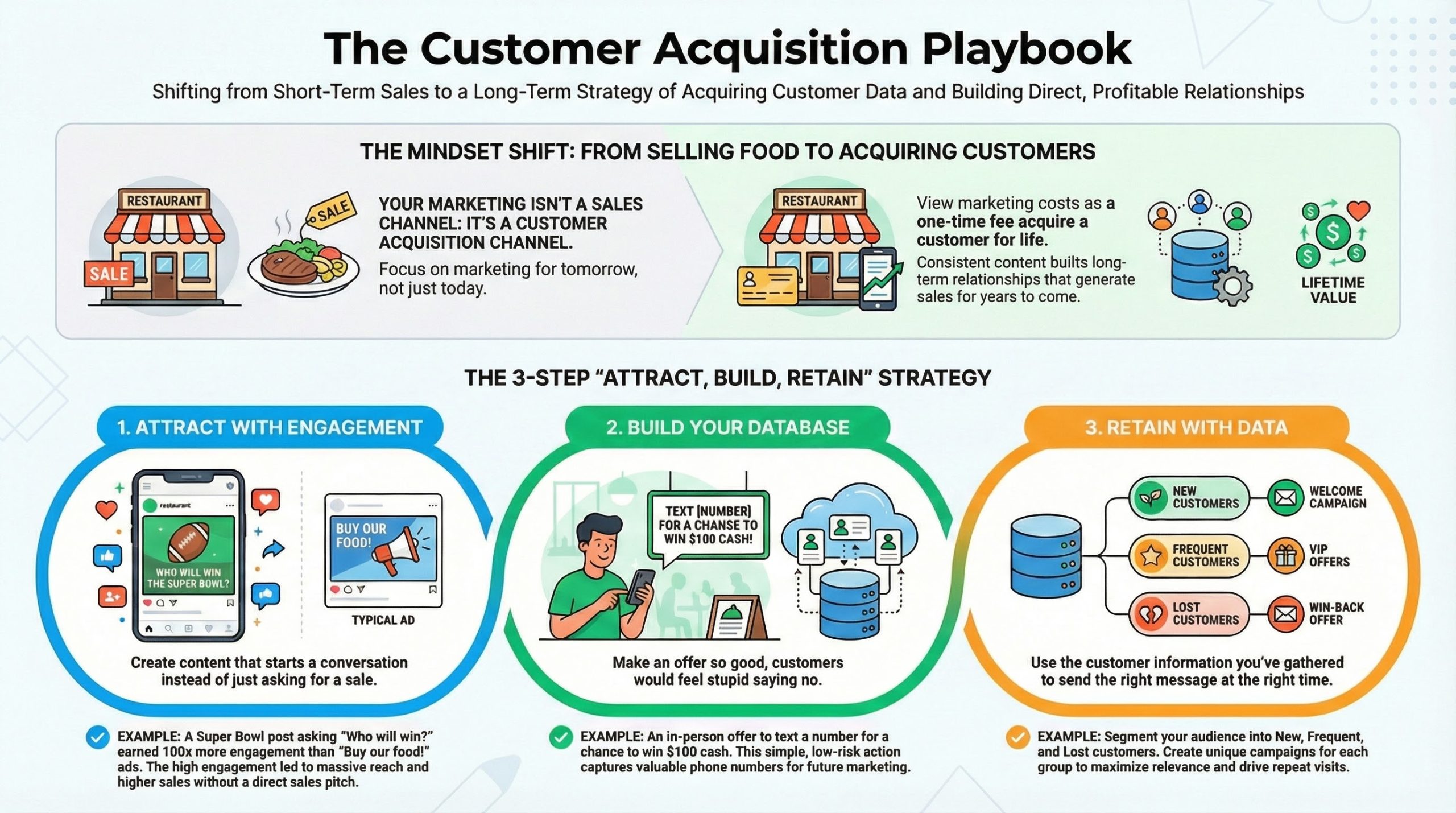
The first step is a fundamental mindset shift. That 30% commission is not a lost margin on a meal; it is the cost to acquire a brand-new customer who might never have found you otherwise. Frame it as an advertising expense. You are paying to have your brand and menu placed in front of a massive, engaged audience that has its credit card out and is ready to buy right now. In part, you’re paying to rent access to their superior, frictionless ordering technology—a user experience that many independent restaurants can’t replicate on their own.
“i was in a discussion in a facebook forum the other day where the person was talking about the third parties now they’ve ruined this ruined that and i said guys it’s an advertising platform it’s a customer acquisition tool.”
You’re not losing a sale. You are buying a lead. The question is, what are you going to do with that lead?
2. The Mission: Pay the Commission Only Once
Your mission is simple and non-negotiable: You will pay the third-party commission for any given customer exactly one time.
Once a customer discovers you and places an order through UberEats, your entire focus must pivot to converting them into a direct customer. Every single order they place after that initial discovery must come through your own channels—your website, your phone line, or your own app. Every repeat order through UberEats isn’t a sale; it’s you paying the customer acquisition cost again for a customer you already won. It’s a leak in your marketing budget that needs to be plugged immediately.
3. The “Hijack” Tactic: Your Trojan Horse in Every Delivery Bag
This is how you execute the mission. The primary tactic is to place a physical insert or flyer inside every single delivery bag that goes out through a third-party service. Think of this flyer as your Trojan Horse—a tool designed to breach the walls of the third-party app, capture the customer’s data, and pull them directly into your ecosystem.
This insert must have a clear and compelling call to action, prominently featuring a QR code. Crucially, this QR code must direct the customer to a duplicate, hidden menu page on your website—one that is invisible to general web traffic. Why? Because now you can build a Facebook or Google retargeting audience composed only of people who have physically received a food order from your restaurant. This is a game-changer. It allows you to run hyper-specific marketing campaigns to a proven customer base—customer sentiment surveys, retargeting lunch visitors with dinner offers, or promoting high-margin items—with a precision that is otherwise impossible.
“we ought to have the team make up a graphic a flyer that goes on top of inside that bag on top of that first box that says we appreciate your business and we’d love to see you in our restaurant or order direct from us scan this code and get…”
4. The Bait: An Offer So Good They Feel Stupid Saying No
A customer won’t scan a QR code and give you their contact information just because you asked nicely. You need a powerful incentive. The offer on your flyer is the most critical component of this entire strategy.
It cannot be a weak, forgettable discount like “10% off your next order.” And it absolutely cannot be bullshit like a "free cookie with a $5 purchase", which creates friction and kills conversion. The offer must be high-value, frictionless, and instantly desirable. The guiding principle is to create an offer so good they would feel stupid saying no to it. This means giving away something of genuine value with no strings attached.
Examples include:
• A free pizza
• A free entree
• A free dessert
The key is that there should be no purchase necessary. The goal isn’t to make a small profit on their next visit; the goal is to acquire their data. The free item is your new, highly effective customer acquisition cost.
“An offer so good you would feel stupid saying no… I gave you an offer so good that you said why the hell not i then got your data”
5. The Payoff: Owning Your Customer Database
The ultimate purpose of this strategy is to build a proprietary customer database that you control completely. This is the asset you are “hijacking” from the third-party platforms. Once a customer scans the QR code on your flyer and redeems their irresistible offer, you now have their name, email, and phone number.
This is the most valuable outcome imaginable. You are no longer “renting” access to customers from UberEats or DoorDash. You now own the direct relationship. Owning this database is the difference between a marketing strategy built on “hope and pray” and one built on “aim and expect.” You stop hoping customers remember you and praying they return. You start aiming targeted marketing at a known audience and expecting a predictable outcome.
“The biggest reason most restaurants aren’t using a retention strategy is they don’t have anybody to retain they don’t have my name my phone number my email my birthday you’ve got to get that in place…”
Conclusion: From Renter to Owner
The strategic journey is clear. You shift from viewing third-party apps as a costly sales channel to leveraging them as a powerful, top-of-funnel customer acquisition tool. You stop fighting the fees and start making them work for you. The core steps are simple: Reframe the 30% commission as your customer acquisition cost. Make it your mission to pay that commission only once per customer. Use a Trojan Horse flyer in every delivery bag with an irresistible, no-strings-attached offer to capture their data. And finally, use that data to build your own customer list and own the relationship forever.
This isn’t just about reclaiming profits; it’s about building an unassailable business asset. While your competitors are stuck in the “hope and pray” cycle, forever renting access to customers from third-party apps, you will be operating on a completely different level. You will aim your marketing with precision and expect results, building a direct line to your customers that no app or competitor can ever take away.