The Topside Gamble
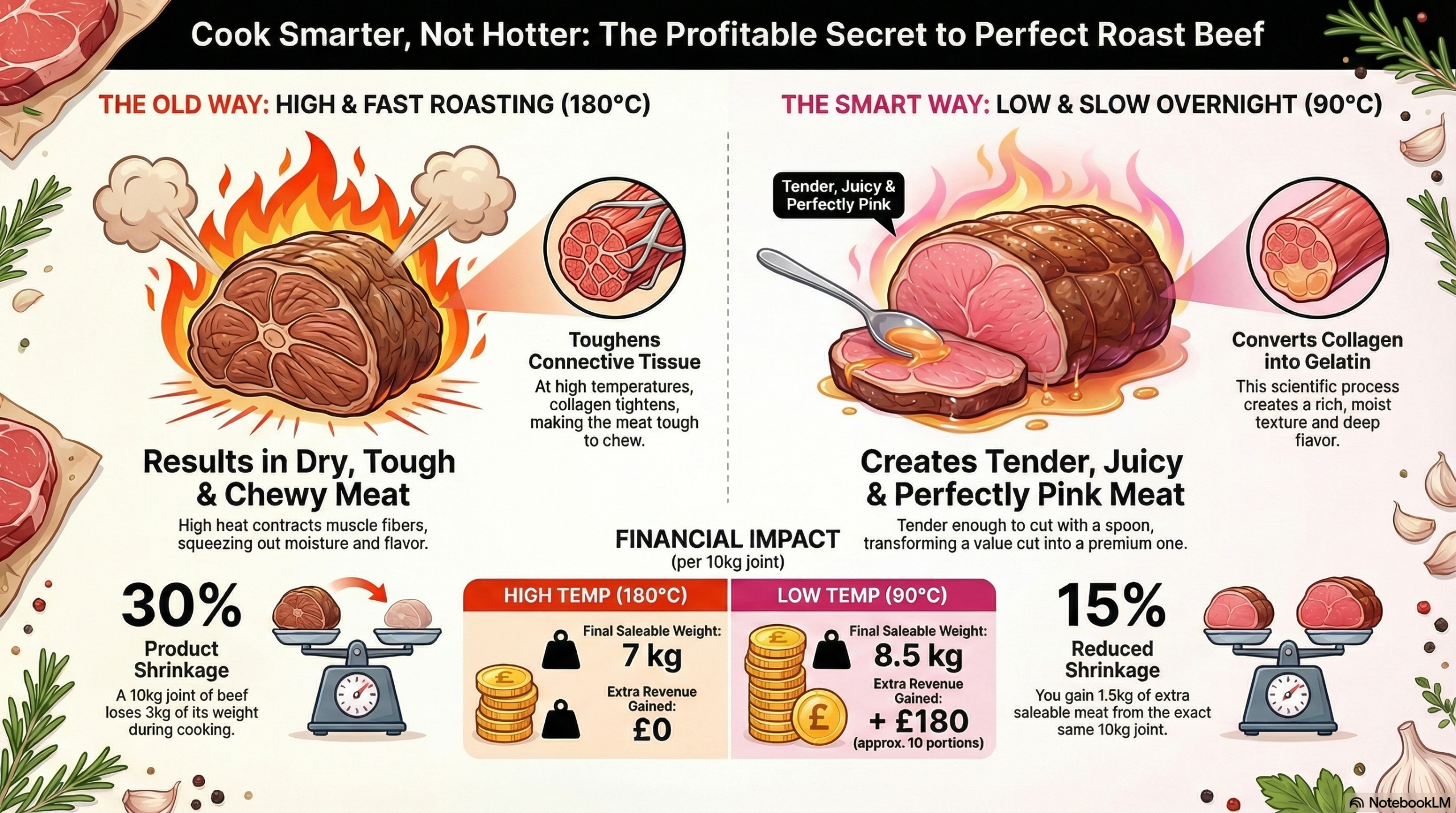
Topside of Beef is the Russian Roulette of the pub trade. It is a lean, hard-working muscle from the rear of the cow. It has very little intramuscular fat (marbling). If you blast it at 180°C for 2 hours, the muscle fibres contract tight, squeezing out every drop of moisture. The result? A grey, dry, chewy slab of meat that requires a steak knife and a strong jaw to get through.
Yet, 90% of pubs still cook it this way because “it’s faster.” They are trading speed for quality. And they are paying for it in complaints and leftovers.
If you want to serve Topside that eats like Sirloin—pink from edge to edge and tender enough to cut with a spoon—you have to stop cooking with heat and start cooking with Time.
Slow Cooking Beef Topside Overnight:
How to Turn Shoe Leather into Silk
The Topside Gamble: Trading speed for quality is costing your pub a fortune.
The Hook: The Topside Gamble
Topside of Beef is the Russian Roulette of the pub trade. It is a lean, hard-working muscle from the rear of the cow. It has very little intramuscular fat (marbling).
If you blast it at 180°C for 2 hours, the muscle fibres contract tight, squeezing out every drop of moisture. The result? A grey, dry, chewy slab of meat that requires a steak knife and a strong jaw to get through.
Yet, 90% of pubs still cook it this way because “it’s faster.” They are trading speed for quality. And they are paying for it in complaints and leftovers.
If you want to serve Topside that eats like Sirloin—pink from edge to edge and tender enough to cut with a spoon—you have to stop cooking with heat and start cooking with Time.
The Philosophy: The Alchemy of Collagen
This is pure kitchen science.
Toughness in meat comes from connective tissue (collagen). At high heat, collagen tightens. At low heat over a long period, collagen breaks down into gelatin.
Gelatin is what gives that sticky, moist, rich mouthfeel.
By switching to an overnight slow cook, you are performing alchemy. You are taking a “cheaper” cut (Topside) and chemically altering its structure to mimic a “premium” cut (Rib or Sirloin).
Rory Sutherland would call this “Value Creation.” You aren’t buying better meat; you are processing it better. You are adding value through patience, not purchase price.
The Tactics: The Overnight Protocol
Do not just turn the oven down and hope. You need a precise thermal strategy. Here is the Chef’s Guide to the overnight roast.
The Sear (The Maillard Reaction)
You cannot get a crust at 100°C.
The Tactic: Before the meat goes into the slow cook (or after—”Reverse Sear”), you must sear the outside. Pan-sear in smoking hot fat or blast in a 240°C oven for 15 minutes. This kills surface bacteria and creates the flavour crust.
The “Delta T” Setting (For Combi Ovens)
If you have a Rational or Unox Combi oven, use the “Delta T” setting.
The Science: This maintains a constant difference between the core temperature probe and the oven air temperature. The Result: The gentlest possible cook. No grey ring around the edge. Just uniform pinkness.
The Temperature Targets
Forget “Time” (e.g., “20 mins per lb”). Cook to temperature.
- Oven Temp: 85°C – 100°C (Low Fan).
- Target Core Temp: 54°C (Medium Rare).
- Time: usually 10-12 hours depending on size.
Put it in at 10:00 PM on Saturday. Walk in at 9:00 AM on Sunday to perfection.
Humidity is Key
Dry heat dries meat.
The Tactic: If you don’t have a steam injection oven, place a deep tray of water at the bottom of the oven. This creates a humid environment that reduces evaporation from the meat.
The Hold
The beauty of low-temp cooking is that you can hold it there. Once the meat hits 54°C, you can drop the oven temp to 54°C. The meat won’t overcook. It will just sit there, happily waiting for service. It effectively “rests” while cooking.
The Software Pitch: The Yield Revolution
Why go through this hassle? Money.
High Temp Roast (180°C):
30% Shrinkage. (10kg becomes 7kg).
Low Temp Roast (90°C):
15% Shrinkage. (10kg becomes 8.5kg). You gain 1.5kg!
That is roughly 10 extra portions. That is £180 extra revenue from the exact same joint.
You need the Roast Forecaster. This tool proves the math.
Stop burning your profit away in a hot oven. Cook slow, sell more.
The Conclusion
Overnight cooking requires nerve. The first time you leave the oven on all night, you will worry.
But when you carve that first slice on Sunday morning—pink, tender, and full of juice—you will never go back.
The cows have done their hard work. Now let the oven do yours.
The Philosophy: The Alchemy of Collagen
This is pure kitchen science. Toughness in meat comes from connective tissue (collagen). At high heat, collagen tightens. At low heat over a long period, collagen breaks down into gelatin. Gelatin is what gives that sticky, moist, rich mouthfeel.
By switching to an overnight slow cook, you are performing alchemy. You are taking a “cheaper” cut (Topside) and chemically altering its structure to mimic a “premium” cut (Rib or Sirloin). Rory Sutherland would call this “Value Creation.” You aren’t buying better meat; you are processing it better. You are adding value through patience, not purchase price.
The Tactics: The Overnight Protocol
Do not just turn the oven down and hope. You need a precise thermal strategy. Here is the Chef’s Guide to the overnight roast.
1. The Sear (The Maillard Reaction) You cannot get a crust at 100°C.
- The Tactic: Before the meat goes into the slow cook (or after—”Reverse Sear”), you must sear the outside.
- Pan-sear in smoking hot fat or blast in a 240°C oven for 15 minutes. This kills surface bacteria and creates the flavour crust.
2. The “Delta T” Setting (For Combi Ovens) If you have a Rational or Unox Combi oven, use the “Delta T” setting.
- The Science: This maintains a constant difference between the core temperature probe and the oven air temperature.
- If the core is 40°C, the oven sits at 60°C. As the core rises to 50°C, the oven rises to 70°C.
- The Result: The gentlest possible cook. No grey ring around the edge. Just uniform pinkness.
3. The Temperature Targets Forget “Time” (e.g., “20 mins per lb”). Cook to temperature.
- Oven Temp: 85°C – 100°C (Low Fan).
- Target Core Temp: 54°C (Medium Rare).
- Time: usually 10-12 hours depending on size.
- Put it in at 10:00 PM on Saturday. Walk in at 9:00 AM on Sunday to perfection.
4. Humidity is Key Dry heat dries meat.
- The Tactic: If you don’t have a steam injection oven, place a deep tray of water at the bottom of the oven. This creates a humid environment that reduces evaporation from the meat.
- Yield Win: This drastically reduces shrinkage.
5. The Hold The beauty of low-temp cooking is that you can hold it there. Once the meat hits 54°C, you can drop the oven temp to 54°C. The meat won’t overcook. It will just sit there, happily waiting for service. It effectively “rests” while cooking.
The Software Pitch: The Yield Revolution
Why go through this hassle? Money.
- High Temp Roast (180°C): 30% Shrinkage. (10kg becomes 7kg).
- Low Temp Roast (90°C): 15% Shrinkage. (10kg becomes 8.5kg).
You gain 1.5kg of saleable beef just by changing the oven dial. That is roughly 10 extra portions. That is £180 extra revenue from the exact same joint.
You need the Roast Forecaster.
This tool proves the math.
- Select “Cooking Method: Slow/Low.”
- Watch the shrinkage percentage drop.
- Watch your profit margin skyrocket.
- It calculates exactly when you need to put the meat in to be ready for 12:00 PM service.
Stop burning your profit away in a hot oven. Cook slow, sell more.
👉 Get the tool here: https://smartpubtools.com/sunday-roast-forecaster/
The Conclusion
Overnight cooking requires nerve. The first time you leave the oven on all night, you will worry. But when you carve that first slice on Sunday morning—pink, tender, and full of juice—you will never go back. The cows have done their hard work. Now let the oven do yours.