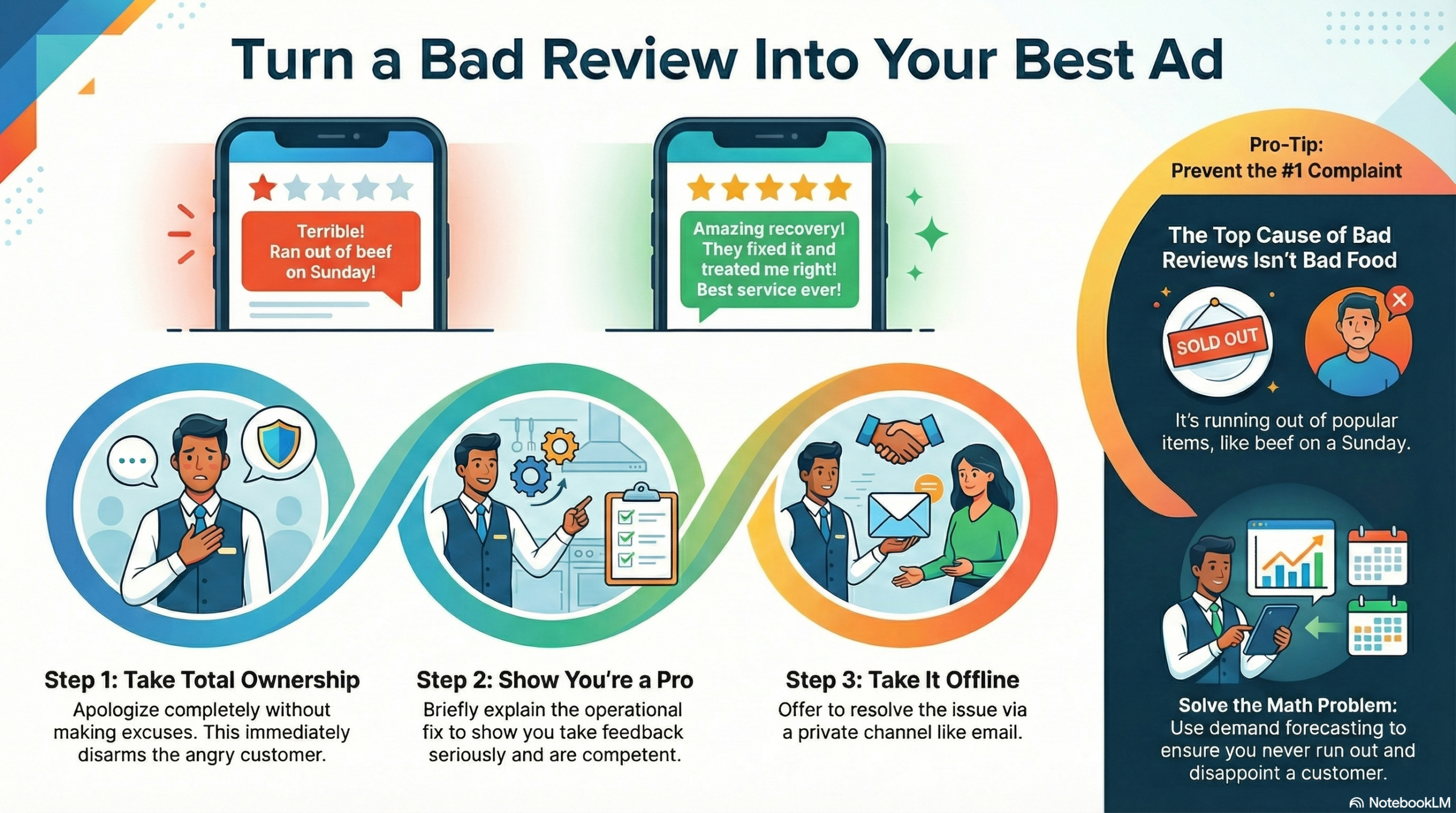
The Monday Morning “TripAdvisor Hangover”
It’s Monday morning. You are exhausted from a 300-cover Sunday service. You open your phone. A notification pops up. 1 Star. “Disappointing. Beef was tough. Potatoes were cold. Ruined our nan’s birthday.”
Your blood boils. You know you served 299 happy people. You know “Nan” arrived 40 minutes late for the booking. You want to reply. You want to fight back. You want to unleash your inner keyboard warrior.
Don’t.
Responding to bad reviews with anger is the fastest way to destroy your reputation. The customer is watching not just what happened, but how you handle it. In the digital age, a bad review isn’t a disaster; it is a stage. It is an opportunity to perform “Service Recovery” in front of an audience of thousands.
The Philosophy: The “Service Recovery Paradox”
Behavioral science gives us the Service Recovery Paradox. This states that a customer who has a problem that is successfully resolved ends up being more loyal to the brand than a customer who never had a problem in the first place.
Why? Because trust is built in the repair. If everything goes perfectly, the customer assumes that is “normal.” If something goes wrong and you fix it with grace, speed, and generosity, you demonstrate character.
Seth Godin would also tell you that a perfect 5.0 rating looks fake. A 4.8 rating with a few handled complaints looks real. It shows you are human. Your goal in the reply is not to win the argument with “Nan.” It is to win the respect of the 500 future customers reading the review.
The Tactics: The 3-Step De-Escalation Protocol
Put the phone down. Wait 24 hours. Then use this structure.
1. The “Total Ownership” (No ‘Buts’) Most landlords apologise like politicians. “I’m sorry IF you felt the beef was tough.” That is an insult. It blames the customer’s feelings.
- The Tactic: Own the failure completely, even if you don’t agree.
- “I am incredibly sorry that the beef was tough. That is not our standard, and I am gutted that we let you down on such a special occasion.”
- Why: It disarms them. You cannot fight someone who is agreeing with you.
2. The “Operational Peek” (Show Competence) Don’t just say sorry; explain why it won’t happen again. This shows you are a professional operator, not a chaotic amateur.
- The Tactic: Briefly mention the fix.
- “We take this seriously. I have reviewed the kitchen logs with the Head Chef this morning to understand why that joint was not up to our usual tenderness. We have adjusted our resting times immediately.”
- This signals: “We have standards. We have logs. We are experts.”
3. The “Offline” Bridge Never negotiate compensation in public.
- The Tactic: Move them to email.
- “Please email me directly at [email]. I would love to invite you back on me to show you what our roast should really taste like.”
- Why: It shows the public you are generous, but it keeps the “freebie hunters” away because they don’t see exactly what you gave them.
The Software Pitch: Fix the Root Cause
Let’s look at the data. What is the #1 cause of bad Sunday reviews? Usually, it’s not “tough beef.” It’s “They ran out.” “We booked for 3pm and they had no beef left. Only turkey. Fuming.”
You can write the best apology in the world, but you still ruined their Sunday. The only way to stop these reviews is to stop running out of food. And running out of food is a math problem, not a chef problem.
You need the Roast Forecaster.
This tool prevents the 1-star review before it happens.
- It predicts the demand for each meat type.
- It ensures you order enough Topside to feed the 4:00 PM table.
- It highlights the risk: “Warning: Your current order volume will leave you short by 15 portions.”
Don’t spend your Mondays apologising. Spend your Mondays counting the profit from a flawless service.
👉 Get the tool here: https://smartpubtools.com/sunday-roast-forecaster/
The Conclusion
You cannot please everyone. You will get bad reviews. But remember: The review is written in ink. Your response is written in character. Be gracious. Be professional. And use the feedback (and the software) to ensure you never make the same mistake twice.