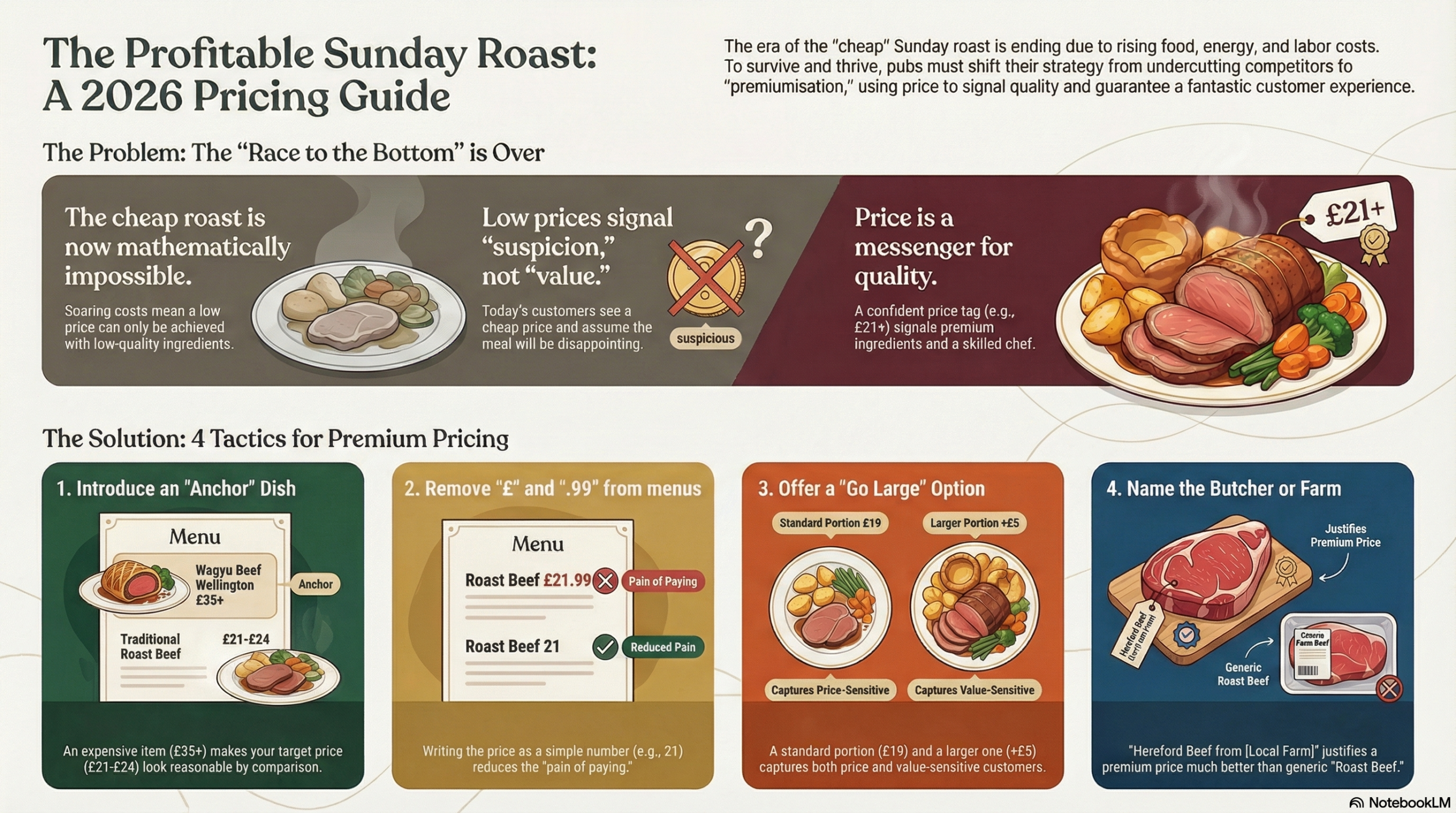
The “Race to the Bottom” is a Suicide Mission
If you are looking at the pub down the road charging £12.95 for a roast and thinking, “I need to match them,” stop.
That pub will be closed by 2026.
The era of cheap meat is over. Energy prices, minimum wage increases, and food inflation mean that the “cheap roast” is mathematically impossible unless you are serving frozen turkey roll and powdered gravy.
As we look toward 2026, the strategy cannot be “undercutting.” The strategy must be “premiumisation.” Customers know costs have gone up. They are not looking for the cheapest meal; they are looking for the meal that guarantees they won’t be disappointed.
A low price doesn’t signal “value” anymore. It signals “suspicion.”
The Philosophy: Price as a Proxy for Quality
Rory Sutherland famously argues that price is a messenger. We don’t just pay for the product; the price informs us about the quality of the product.
If you see a bottle of wine for £4, you assume it tastes like vinegar. If you see a Roast Beef for £14 in 2025/26, you assume the meat is tough, the potatoes are frozen, and the chef doesn’t care.
By pricing too low, you are actually marketing yourself as “low quality.” Conversely, a confident price tag (e.g., £21-£24) signals: “This is excellent beef. We are proud of it. We buy it from a real butcher.”
You are not selling calories. You are selling a guarantee of a good Sunday afternoon. People will pay for that certainty.
The Sunday Roast Forecaster
Scenario plan your 2026 pricing strategy for maximum Gross Profit (GP).
Input Your Variables (Current Costing)
Profit Analysis
Total Ingredient Cost (CoGS)
£0.00
Gross Profit (GP) Amount
£0.00
Gross Profit (GP) Percentage
0.0%
Target GP for a successful operation is typically 65-70%. Use a confident price tag to hit the sweet spot!
The Tactics: Menu Engineering for Maximum Yield
You need to increase your prices. Here is how you do it without scaring the regulars away.
1. The “Anchor” Dish (The Decoy) This is the oldest trick in the behavioral economics book, and it works every time. You need a dish on the menu that is absurdly expensive.
- The Tactic: Add a “Sharing Board of Local Meats” or a “Premium Rib of Beef” for £35.00.
- The Result: Nobody buys it (or very few do). But suddenly, your £21.00 Topside of Beef looks “reasonable” by comparison. If the most expensive thing is £21, it feels expensive. If the most expensive thing is £35, £21 feels like the safe, middle-ground choice.
2. Kill the “£” and the “.99” In 2026, menus with “£16.99” look like a roadside diner or a bargain bucket.
- The Tactic: Remove the currency symbol. Remove the decimals.
- Write: Roast Topside of Beef — 21
- Why: Research shows that removing the “£” sign reduces the “pain of paying.” It turns the transaction from a financial decision into a gastronomic one. And never use “.99” or “.95” on a Sunday. It screams “cheap.” integers denote confidence.
3. The “Go Large” Option Some customers are price sensitive. Some are value sensitive. You need to capture both.
- The Tactic: Keep your “Standard” roast at a competitive entry price (e.g., £19).
- The Upsell: Offer a “Landlord’s Portion” or “Go Large” for +£5.
- This gives you a blended average spend of £22+, but allows you to advertise the “starting from” price of £19. It puts the power in the customer’s hands.
4. Name the Butcher “Roast Beef” is a commodity. “28-Day Aged Hereford Beef from [Local Farm]” is a story.
- The Tactic: Provenance adds value. If you name the farm or the breed, you justify the £2 price hike. You are selling a specific animal, not generic protein.
The Software Pitch: Model the Future
How do you know if £21 is the right price? Or £24? If beef prices rise by another 10% in 2026, what does that do to your bottom line?
Most landlords just “add a quid” and hope for the best. That is reckless.
You need the Roast Forecaster.
This tool lets you scenario-plan your pricing strategy.
- Input your current meat costs.
- Adjust the “Sale Price” slider to see how it affects your GP percentage.
- “What if I charge £22 but add an extra Yorkshire Pudding? Does my GP hold up?”
- The tool gives you the answer instantly.
It allows you to find the “Sweet Spot”—the price where the customer is happy, and your bank manager is happy.
👉 Get the tool here: https://smartpubtools.com/sunday-roast-forecaster/
The Conclusion
Don’t apologise for your prices. In 2026, the pubs that survive will be the ones that charged enough to pay for great staff, great produce, and a warm environment. The pubs that try to be the “cheapest in town” will simply run out of cash.
Be expensive. Be worth it.