The “Thin Jus” Insult
Imagine being a Coeliac customer on a Sunday. You look around the table. Everyone else has thick, glossy, rib-sticking gravy clinging to their roast potatoes. Then your plate arrives. It is swimming in a watery, translucent “jus” that looks like beef tea. It runs off the potatoes. It creates a puddle at the bottom of the plate.
It screams: “We couldn’t be bothered to make you real gravy.”
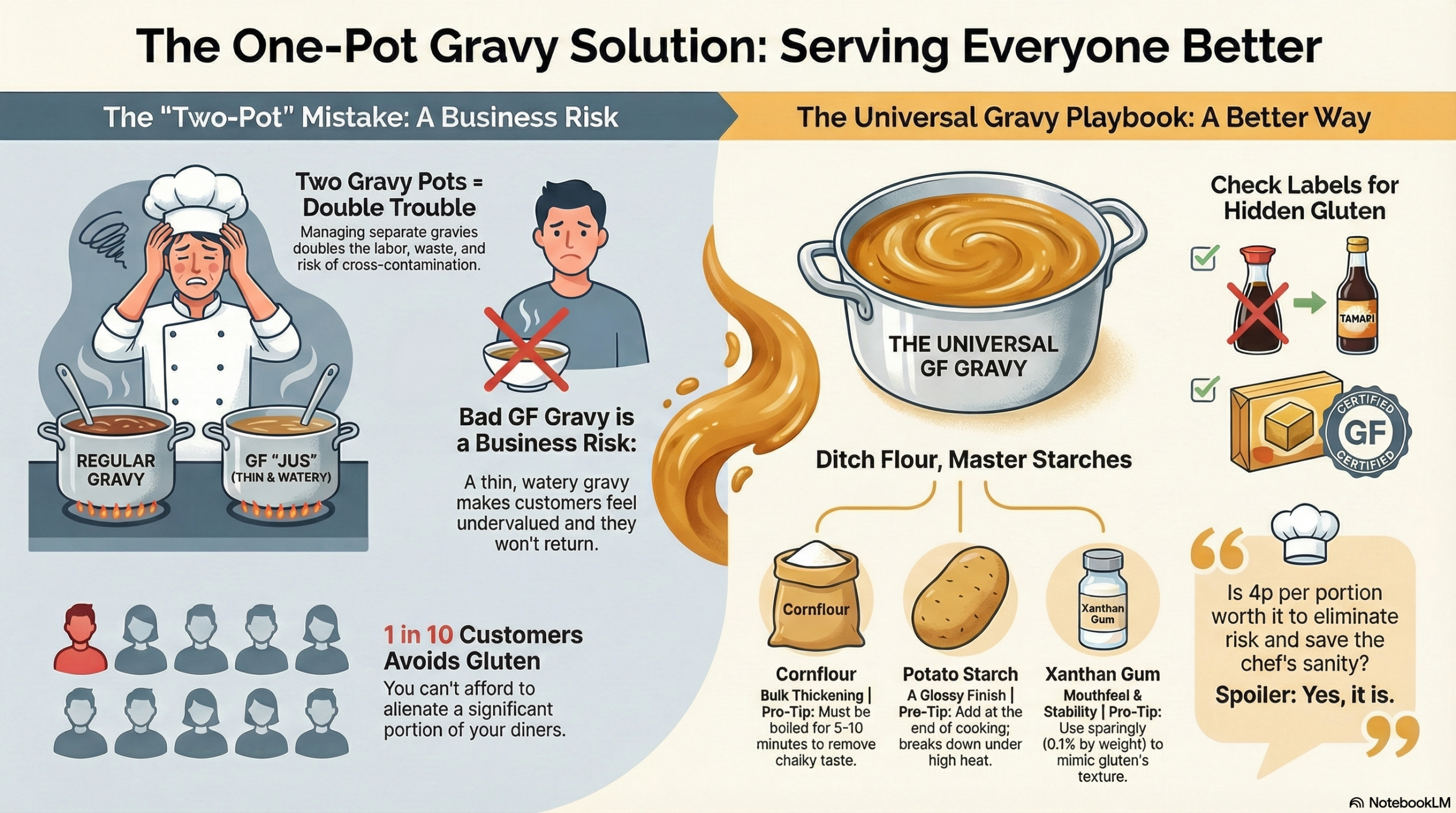
In 2025, offering a sub-standard Gluten-Free (GF) gravy is a hospitality failure. With 1 in 10 customers avoiding gluten (either medically or by choice), you cannot afford to alienate them. The goal is simple: Make a GF gravy so good that you can serve it to everyone, eliminating the need for two separate pots on the stove.
Gluten-Free Gravy Commercial Recipes: How to Ditch the Flour Without Losing the Flavour
The Hook: The “Thin Jus” Insult
Imagine being a Coeliac customer on a Sunday. You look around the table. Everyone else has thick, glossy, rib-sticking gravy clinging to their roast potatoes.
Then your plate arrives. It is swimming in a watery, translucent “jus” that looks like beef tea. It runs off the potatoes. It creates a puddle at the bottom of the plate.
It screams: “We couldn’t be bothered to make you real gravy.”
In 2025, offering a sub-standard Gluten-Free (GF) gravy is a hospitality failure. With 1 in 10 customers avoiding gluten (either medically or by choice), you cannot afford to alienate them.
The Philosophy: The “Universal Design” Principle
In architecture, “Universal Design” means building a ramp that everyone uses, rather than a separate staircase for some and a hidden lift for others.
In the kitchen, this is the holy grail. Why have a “Normal” gravy (Roux-based) and a “Special” gravy (Cornflour-based)? That doubles the labor, doubles the pot wash, and doubles the risk of the wrong ladle going in the wrong pot (Cross-Contamination).
Will Guidara would argue that “Unreasonable Hospitality” is giving the Coeliac customer the exact same visceral experience as the non-Coeliac. Thick, rich, comforting.
If you can crack the “Master GF Gravy,” you simplify your operation and improve the guest experience simultaneously.
The Tactics: The Science of Starch
You can’t use Wheat Flour (Roux). So what do you use? Here is the commercial playbook for GF thickening.
1. Cornflour (Cornstarch) – The Standard
- Pros: Cheap, easy, gluten-free.
- Cons: If not cooked out, it has a chalky texture. It can turn “gloopy” if held too long.
The Tactic: Do not add it as a powder. Make a “Slurry” (cold water + cornflour mixed). Whisk it into the boiling stock. Crucial: You must boil it for at least 5-10 minutes to activate the starch fully and remove the chalky taste.
2. Potato Starch – The Gloss King
- Pros: Creates a cleaner, glossier finish than cornflour.
- Cons: It breaks down under high heat if boiled for too long.
The Tactic: Use this for finishing. It gives that “mirror glaze” look to the gravy.
3. Xanthan Gum – The Texture Hack
- Pros: You need a tiny amount. It mimics the “mouthfeel” of gluten.
- Cons: Use too much and your gravy texture becomes “snotty” (sorry, but it’s true).
The Tactic: Use 0.1% by weight. Ideally, blend it in. It stabilizes the emulsion and stops the fat separating.
The “Umami” Boosters (Watch the Label)
Most chefs ruin GF gravy by adding condiments that contain wheat.
- Soy Sauce: usually contains wheat. Swap for Tamari.
- Marmite: contains gluten (yeast extract often from barley). Swap for GF Yeast Extract.
- Stock Cubes: Many commercial bouillon pastes contain gluten. Check the tub.
5. The “One Pot” Protocol
The best commercial move is to ban wheat flour from the gravy section entirely.
- Make 20 Litres of Stock.
- Thicken the whole batch with Cornflour/Potato Starch.
- Season with Tamari.
Now, everyone gets the thick gravy. No risk. No confusion. The waiters don’t have to ask “Which jug is which?”
The Software Pitch: The Cost of Compliance
GF ingredients (Tamari, GF Bouillon) are more expensive than their standard counterparts.
Do you know by how much? Is it 2p per portion or 20p?
You need the Roast Forecaster.
This tool allows you to build your “Master Gravy” recipe and see the impact. It tells you: “Switching to a universal GF gravy will cost you an extra £0.04 per portion.”
You can then decide: “Is 4p worth it to eliminate the risk of poisoning a customer and saving the chef’s sanity?” (Spoiler: Yes, it is).
The Conclusion
Stop treating GF gravy as an inconvenience.
If you serve a Coeliac customer a watery jus, they won’t complain. They just won’t come back.
Thicken it up. Check the labels. And simplify your life by making one amazing pot that everyone can eat.
The Philosophy: The “Universal Design” Principle
In architecture, “Universal Design” means building a ramp that everyone uses, rather than a separate staircase for some and a hidden lift for others. In the kitchen, this is the holy grail. Why have a “Normal” gravy (Roux-based) and a “Special” gravy (Cornflour-based)? That doubles the labor, doubles the pot wash, and doubles the risk of the wrong ladle going in the wrong pot (Cross-Contamination).
Will Guidara would argue that “Unreasonable Hospitality” is giving the Coeliac customer the exact same visceral experience as the non-Coeliac. Thick, rich, comforting. If you can crack the “Master GF Gravy,” you simplify your operation and improve the guest experience simultaneously.
The Tactics: The Science of Starch
You can’t use Wheat Flour (Roux). So what do you use? Here is the commercial playbook for GF thickening.
1. Cornflour (Cornstarch) – The Standard
- Pros: Cheap, easy, gluten-free.
- Cons: If not cooked out, it has a chalky texture. It can turn “gloopy” if held too long.
- The Tactic: Do not add it as a powder. Make a “Slurry” (cold water + cornflour mixed). Whisk it into the boiling stock. Crucial: You must boil it for at least 5-10 minutes to activate the starch fully and remove the chalky taste.
2. Potato Starch – The Gloss King
- Pros: Creates a cleaner, glossier finish than cornflour.
- Cons: It breaks down under high heat if boiled for too long.
- The Tactic: Use this for finishing. It gives that “mirror glaze” look to the gravy.
3. Xanthan Gum – The Texture Hack
- Pros: You need a tiny amount. It mimics the “mouthfeel” of gluten.
- Cons: Use too much and your gravy texture becomes “snotty” (sorry, but it’s true).
- The Tactic: Use 0.1% by weight. Ideally, blend it in. It stabilizes the emulsion and stops the fat separating.
4. The “Umami” Boosters (Watch the Label) Most chefs ruin GF gravy by adding condiments that contain wheat.
- Soy Sauce: usually contains wheat. Swap for Tamari.
- Marmite: contains gluten (yeast extract often from barley). Swap for GF Yeast Extract.
- Stock Cubes: Many commercial bouillon pastes contain gluten. Check the tub.
5. The “One Pot” Protocol The best commercial move is to ban wheat flour from the gravy section entirely.
- Make 20 Litres of Stock.
- Thicken the whole batch with Cornflour/Potato Starch.
- Season with Tamari.
- Now, everyone gets the thick gravy. No risk. No confusion. The waiters don’t have to ask “Which jug is which?”
The Software Pitch: The Cost of Compliance
GF ingredients (Tamari, GF Bouillon) are more expensive than their standard counterparts. If you switch your entire operation to a GF base, your Cost of Goods Sold (COGS) will tick up slightly.
Do you know by how much? Is it 2p per portion or 20p?
You need the Roast Forecaster.
This tool allows you to build your “Master Gravy” recipe and see the impact.
- Input the price of Tamari vs. Soy Sauce.
- Input the price of Cornflour vs. Wheat Flour.
- It tells you: “Switching to a universal GF gravy will cost you an extra £0.04 per portion.”
You can then decide: “Is 4p worth it to eliminate the risk of poisoning a customer and saving the chef’s sanity?” (Spoiler: Yes, it is).
👉 Get the tool here: https://smartpubtools.com/sunday-roast-forecaster/
The Conclusion
Stop treating GF gravy as an inconvenience. If you serve a Coeliac customer a watery jus, they won’t complain. They just won’t come back. Thicken it up. Check the labels. And simplify your life by making one amazing pot that everyone can eat.