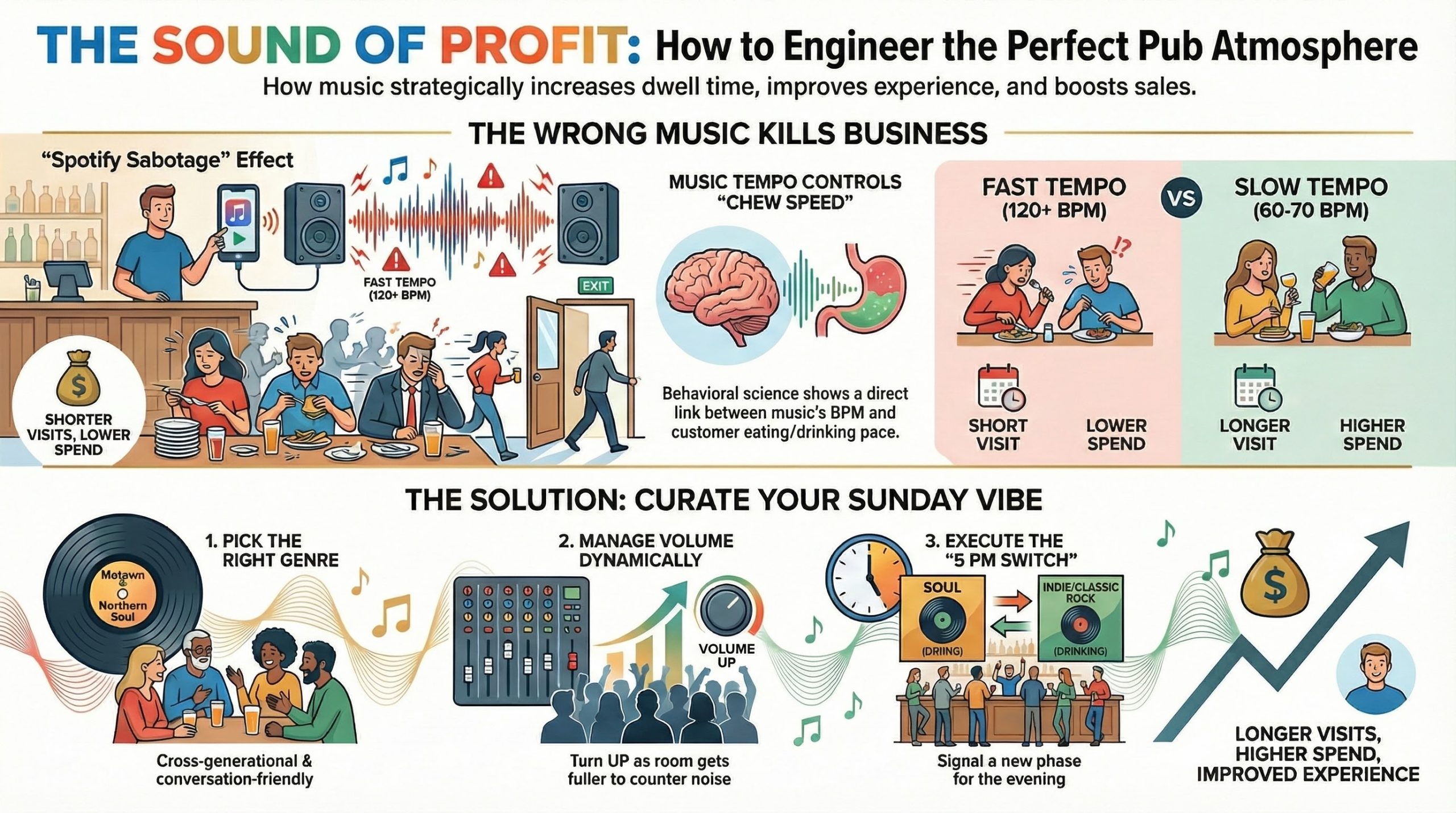
The Spotify Sabotage
It happens in pubs across the UK every Sunday at 2:00 PM. The vibe is good. The roast is flowing. Then, the playlist changes. Suddenly, Skrillex or heavy techno starts blasting out of the speakers because the 19-year-old glass collector connected their phone to the Bluetooth.
Running this problem at your pub?
Here's the system I use at The Teal Farm to fix it — real-time labour %, cash position, and VAT liability in one dashboard. 30-minute setup. £97 once, no monthly fees.
Get Pub Command Centre — £97 →No monthly fees. 30-day money-back guarantee. Built by a working pub landlord.
The room changes instantly. Shoulders tense up. Conversation becomes a shouting match. Grandparents ask for the bill. You just cleared the room. You didn’t clear it because the food was bad; you cleared it because the BPM (Beats Per Minute) was wrong. Music is not “background noise.” It is Atmospheric Engineering. If you leave it to chance—or worse, to the staff—you are gambling with your dwell time.
The Sunday Vibe Auditor
Atmospheric Engineering Tool
Dwell Time Probability
“Grandparents are asking for the bill.”
Malbec Upsell
Low
Chew Speed
Fast
Corrective Actions
Don’t let the Kitchen break the rhythm.
You’ve fixed the playlist. Now fix the Back of House chaos. Predict exactly how many beef portions you need for the 1pm wave.
The Philosophy: The “Chew Speed” Correlation
Behavioral science has proven a direct link between the tempo of background music and the speed at which people eat and drink.
- Fast Music (120+ BPM): People eat faster, drink faster, and leave sooner. (Great for McDonald’s).
- Slow Music (60-70 BPM): People eat slower, relax, order a second bottle of wine, and stay for dessert. (Great for a Gastropub).
Rory Sutherland would point to “Cross-Modal Correspondence”—the idea that what we hear changes what we taste. High-pitched, scratchy music makes wine taste acidic. Deep, soulful, mellow music makes wine taste richer and smoother. If you want to sell £30 bottles of Malbec, you cannot play Drill or Garage. You need to play Soul.
The Tactics: Curating the Sunday Vibe
Stop using “Chart Hits 2024.” Here is the sonic architecture of a profitable Sunday.
1. The “Motown” Goldilocks Zone For Sunday Lunch, Motown and Northern Soul are the undisputed kings.
- The Tactic: Create a “Sunday Soul” playlist.
- Why: It is cross-generational. The 20-year-olds know it (from samples). The 70-year-olds know it (from the original).
- It is upbeat enough to stop people falling asleep, but smooth enough to encourage conversation. It is “sunny” music, even when it’s raining outside.
2. The “Acoustic Cover” Strategy If you want a more modern feel without the aggression of pop production.
- The Tactic: Search for “Acoustic Covers” or “Coffee House” playlists.
- It takes familiar songs (Oasis, The Killers, Taylor Swift) but strips away the drums and electric guitars.
- It provides the dopamine hit of “recognition” (“Oh, I know this song”) without the sonic clutter that interrupts chat.
3. The Volume “Sweet Spot” (The Lombard Effect) The Lombard Effect is the tendency for people to raise their voices when the background noise increases.
- The Tactic: You must manage the volume dynamically.
- 12:00 PM (Empty Room): Keep it low. If it’s loud in an empty room, it feels intimidating.
- 1:30 PM (Full Room): Turn it UP.
- Counter-intuitive? Yes. But human bodies absorb sound. A full room dampens the acoustics. If you don’t turn it up, the music disappears, and all you hear is the clatter of cutlery (which is stressful). You need to ride the fader.
4. The 5:00 PM Switch Sunday has two distinct phases: “Dining” and “Drinking.”
- The Tactic: At 5:00 PM, when the last plates are cleared and the “Sunday Club” drinkers arrive, the playlist must change.
- Shift from Soul/Acoustic to Indie/Classic Rock (Fleetwood Mac, Stones, Arctic Monkeys).
- Increase the tempo. Signal to the room: “Dinner is over. The bar is open.”
The Software Pitch: Rhythm in the Kitchen
You have optimized the rhythm of the dining room. What about the rhythm of the kitchen? If the music is smooth but the kitchen is in chaos, the vibe is broken. Chaos in the kitchen comes from one thing: Unpredictability.
You need to know exactly what is coming so the kitchen can hum along like a well-oiled machine.
You need the Roast Forecaster.
This tool is the conductor of your kitchen.
- It sets the tempo. “You need 40 portions of beef for the 1pm wave.”
- It prevents the “stopped music” moment where you run out of food and the chef starts screaming.
- It keeps the Back of House as chilled as the Front of House playlist.
Get the rhythm right, front and back.
👉 Get the tool here: https://smartpubtools.com/sunday-roast-forecaster/
Used daily at Teal Farm Pub, Washington NE38
The Pub Command Centre handles everything in this article — without a spreadsheet.
Wet GP%, dry GP%, labour costs, beer line cleaning logs (12 lines), HACCP temperature checks, stock ordering, weekly P&L. All in one system. Used every shift at Teal Farm where labour runs at 15.1% against a UK pub average of 25-30%.
On a pub taking £900k a year, running labour at 15% instead of 25% is worth roughly £90,000. That is what tracking it daily — every shift, every week — actually looks like.
£97 once. No subscription. No monthly fee. Works on any phone, tablet or laptop. Setup under 10 minutes. Built and used by a Marston’s CRP licensee with a 5-star EHO rating and 180 covers.
See the Pub Command Centre — £97 →One-off payment. Works on any device. Used by a working licensee, not a software company that’s never pulled a pint.
The Conclusion
📊 Your EPOS tells you what sold. Pub Command Centre tells you whether you made money.
Real-time labour %, cash position and VAT liability in one dashboard. Built by a working pub landlord. £97 once, no monthly fees. 30-day money-back guarantee.
Get Pub Command Centre — £97 →Don’t let the algorithm choose your atmosphere. Curate it. Keep it slow, keep it soulful, and keep the volume matched to the crowd. If the customers are tapping their feet, they are opening their wallets.
Running your pub on gut feel?
The Pub Command Centre gives you wet GP%, cellar checks, staff cost and weekly P&L — from your phone, every shift. £97 once. No subscription.
See the Pub Command Centre →