It is 8:30 PM on a Friday. The bar is three deep. You pull a pint of lager, and it explodes into a glass full of white foam. You pour it away. You try again. Foam.
You check the gas pressure. You check the cellar temperature. You check the cooler. Everything looks fine.
Running this problem at your pub?
Here's the system I use at The Teal Farm to fix it — real-time labour %, cash position, and VAT liability in one dashboard. 30-minute setup. £97 once, no monthly fees.
Get Pub Command Centre — £97 →No monthly fees. 30-day money-back guarantee. Built by a working pub landlord.
So why is your beer fobbing?
Most landlords blame the equipment. But in 80% of cases, the problem isn’t mechanical. It is biological.
Your beer is fobbing because your lines have Nucleation Points caused by biofilm. And no amount of fiddling with the gas regulator will fix it.
The Fobbing Fixer
“It is biology, not mechanics.”
1 Diagnose The Problem
Before you touch the gas regulator, tell us exactly what is happening:
2 The Cost of Fobbing
Fobbing isn’t just annoying; it is theft. See how much that “little bit of froth” is actually costing you.
You are throwing away
PER YEAR
Investing £20 in sponge balls is the cheapest insurance policy you will ever buy.
© 2025 Smart Pub Tools.
The Science: What is a “Nucleation Point”?
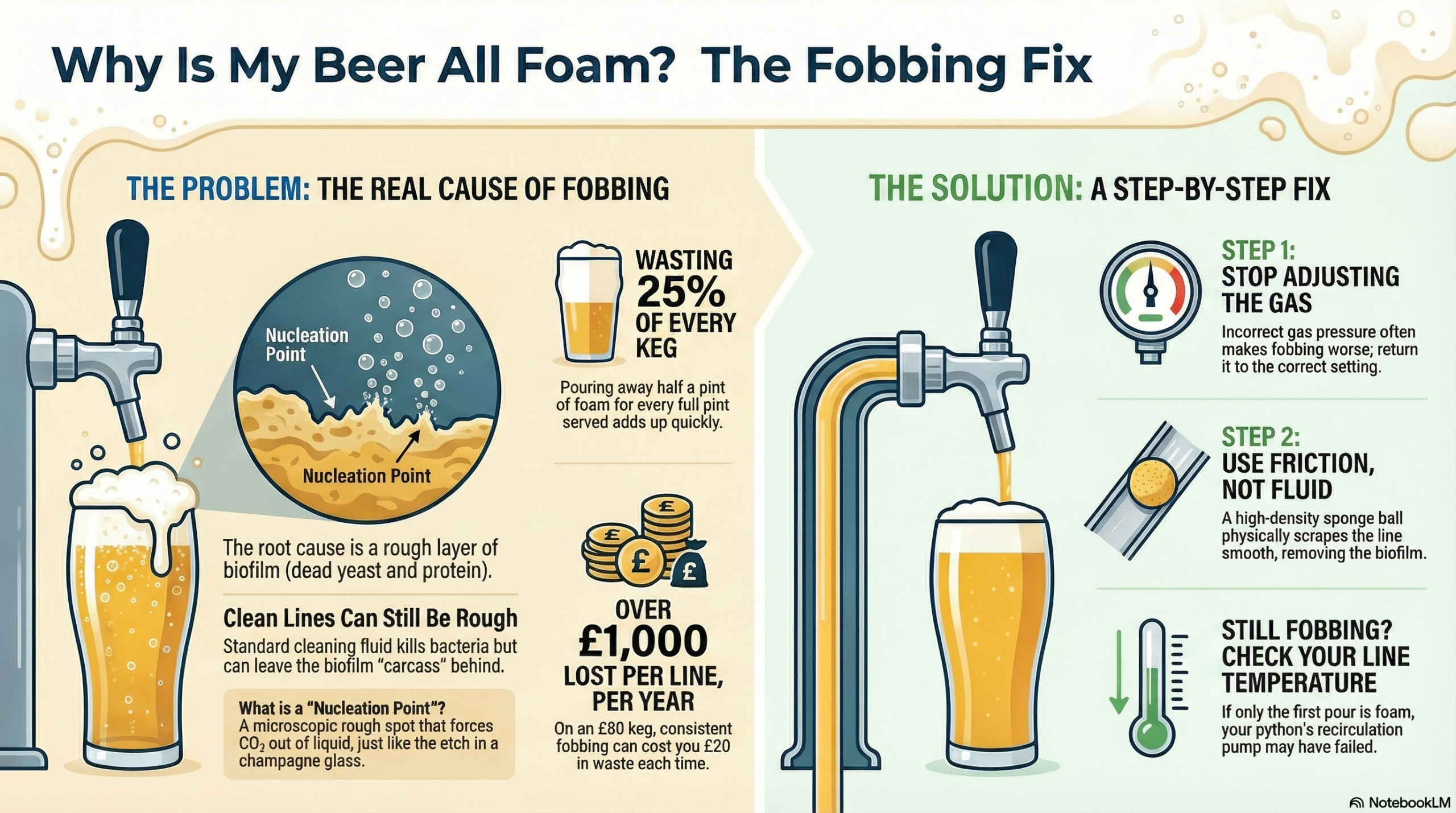
To understand fobbing, look at a champagne flute. You know how bubbles rise in a perfect stream from the bottom of the glass? That happens because the glass manufacturer etched a tiny scratch (a nucleation point) at the base. When CO2 hits a rough surface, it breaks out of the liquid and turns into gas.
Now, apply this to your beer lines.
A clean beer line is smooth like glass. The beer glides over it. A dirty beer line is rough. It is coated in Biofilm (a layer of dead yeast and protein).
- As the beer travels from the cellar to the bar, it hits millions of these microscopic rough spots.
- Each spot acts like the scratch in a champagne glass.
- The CO2 breaks out of the beer inside the line.
- By the time it hits the tap, it is no longer liquid. It is a missile of foam.
The “Fobbing Fix”: The Torpedo Method
If you have cleaned your lines this week and they are still fobbing, your cleaning fluid didn’t work. It killed the bacteria, but it left the rough “carcass” of the biofilm behind.
You need to polish the inside of the pipe smooth again. You cannot do this with fluid. You must do it with friction.
Step 1: Stop Adjusting the Gas
Turning the gas pressure down often makes it worse. If the pressure is too low, the CO2 naturally separates from the beer (breakout), creating even more foam. Put the gas back to the correct setting (usually 32-38 psi for mixed gas).
Step 2: The Mechanical Scrub
You need to run a Sponge Ball through the line.
- The Tool: A 10mm high-density sponge.
- The Action: The sponge compresses against the line walls, physically scraping off the biofilm that is causing the nucleation.
I have seen lines that were “cleaned” yesterday produce a cup full of black slime when a sponge is run through them. Once that slime is gone, the beer pours like silk.
Step 3: The Launch Mechanism
Remember, you cannot push a sponge through with a standard bucket. You need a pressurized system and a Cleaning Socket (Launch Chamber) to fire it.
The “False” Cause: Warmth (The 2-Degree Rule)
If you have torpedoed the lines and it is still fobbing, there is only one other likely culprit: Temperature Spike.
Beer lines are insulated (in a python), but they are not invincible.
- The Danger Zone: The 2 meters of line between your cellar cooling unit and the python exit.
- The Symptom: If the first half-pint is foam, but the second one is fine, your lines are warming up between pours.
- The Fix: Check your “Recirculation Pump” (the water bath motor). Is the water in the python actually moving? If the water bath is cold but the python is warm, your pump impeller has failed.
The Cost of Fobbing
Fobbing isn’t just annoying; it is theft. If you waste just half a pint of froth for every pint you serve during a rush, you are losing 25% of your keg.
- On an £80 keg, you just threw £20 down the drain.
- Multiply that by 52 weeks. You are losing £1,000+ per line, per year.
Investing £20 in a bag of Sponge Balls isn’t an expense. It is the cheapest insurance policy you will ever buy.
For pub and hospitality business insurance, Premierline compare quotes from leading UK insurers in minutes. As a specialist business insurance broker they understand the specific risks pub landlords face — from public liability to employers liability and stock cover. Get a quote from Premierline here.
Stop Guessing, Start Measuring. If you hate waste in your wet stock, why do you accept it in your food stock? We built a tool that predicts your Sunday Roast sales so you never have to bin a Yorkshire Pudding again. Try the Sunday Roast Forecaster Here
📊 Your EPOS tells you what sold. Pub Command Centre tells you whether you made money.
Real-time labour %, cash position and VAT liability in one dashboard. Built by a working pub landlord. £97 once, no monthly fees. 30-day money-back guarantee.
Get Pub Command Centre — £97 →Operators who want to track pub GP% in real time can see how it’s done at Teal Farm Pub (180 covers, NE38, labour at 15%).
Running your pub on gut feel?
The Pub Command Centre gives you wet GP%, cellar checks, staff cost and weekly P&L — from your phone, every shift. £97 once. No subscription.
See the Pub Command Centre →