The “Roadkill” Effect
Let’s be honest. The Sunday Roast is delicious, but it is ugly. It is brown meat, next to brown potatoes, covered in brown liquid, sitting in a brown Yorkshire pudding. When you take a photo of this with a smartphone under yellow pub lights, it doesn’t look like a feast. It looks like a car crash. It looks like sludge.
Running this problem at your pub?
Here's the system I use at The Teal Farm to fix it — real-time labour %, cash position, and VAT liability in one dashboard. 30-minute setup. £97 once, no monthly fees.
Get Pub Command Centre — £97 →No monthly fees. 30-day money-back guarantee. Built by a working pub landlord.
I see thousands of pubs posting photos that actually put people off. You are trying to sell a premium experience (£20+), but your visual marketing looks like a hospital canteen dinner. “Brown Food” is the hardest category in photography. But if you crack it, you dominate the feed. You don’t need a DSLR and a studio. You just need to understand light and contrast.
Stop Your Roast Looking Like “Beige Sludge”
How to Take Photos of Brown Food (Gravy/Meat)
The Hook: The “Roadkill” Effect
Let’s be honest. The Sunday Roast is delicious, but it is ugly. It is brown meat, next to brown potatoes, covered in brown liquid, sitting in a brown Yorkshire pudding.
When you photograph this under yellow pub lights, it doesn’t look like a feast. It looks like sludge. You are trying to sell a premium experience (£20+), but your visual marketing looks like a hospital canteen dinner.
“Brown Food” is the hardest category in photography. If you crack it, you dominate the feed. You just need to understand light and contrast.
The Philosophy: The “Von Restorff” Effect
In psychology, the Von Restorff Effect predicts that an item that “stands out like a sore thumb” is more likely to be remembered.
On Instagram, everything is bright (Avocado toast, Cocktails). A brown roast disappears.
To make brown food “remarkable” (Seth Godin), you cannot rely on the colour of the food. You must rely on Texture and Contrast.
You aren’t photographing dinner; you are photographing physics.
The Tactics: The 4-Step “Brown Food” Fix
Stop taking photos from your eye level at a dark table. Follow this protocol.
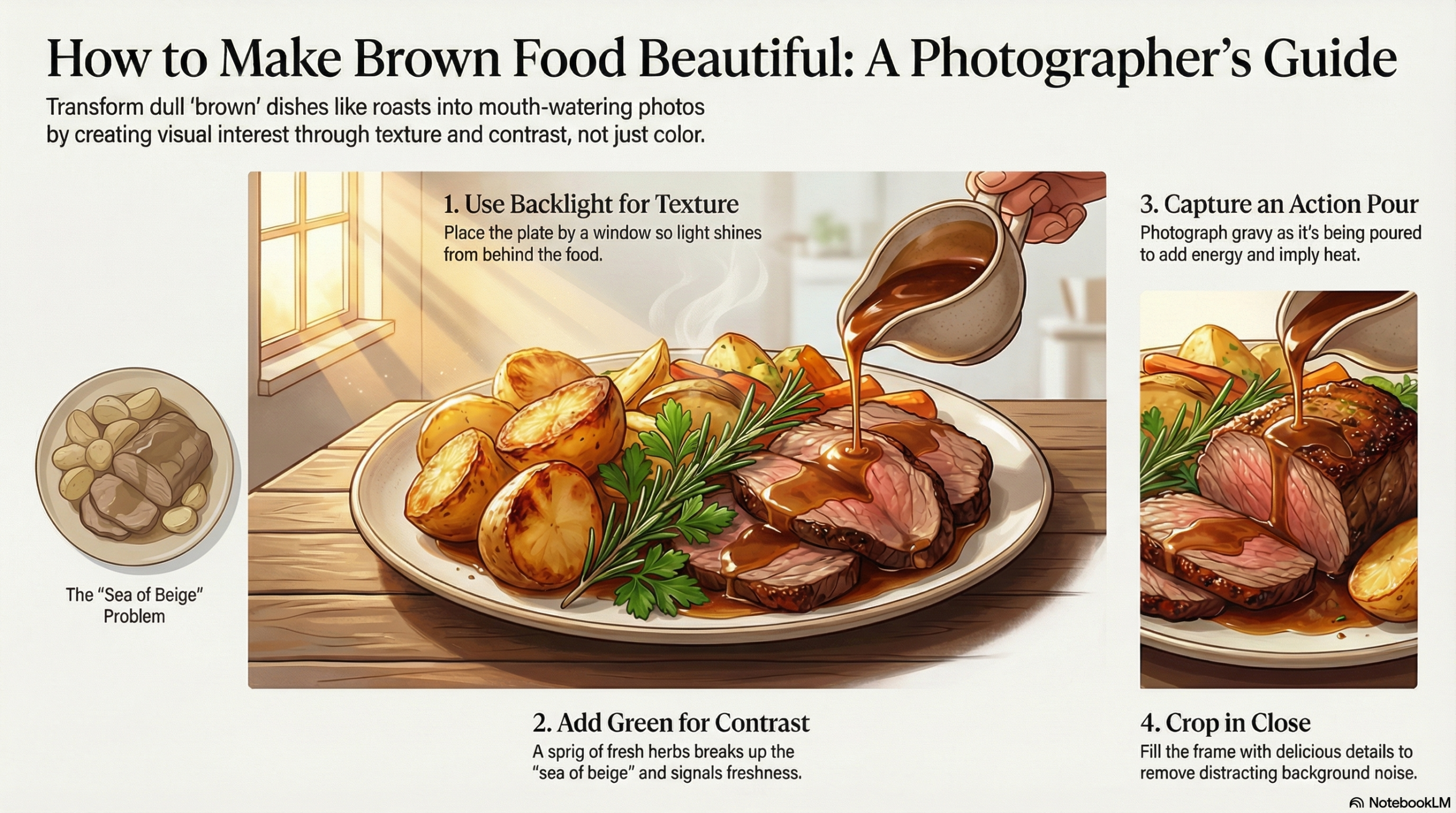
1. The “Backlight” Rule (Texture)
Never, ever use the flash on your phone. It makes meat look greasy and grey.
The Tactic: Take the plate to a window.
Shoot with the window behind the food (or to the side).
Why: Backlight catches the edges of the crispy potato and creates highlights on the gravy. Front light flattens; backlight creates 3D texture.
2. The “Green Breaker” (Contrast)
Brown on brown is boring. The human eye needs an anchor.
The Tactic: You need Green.
Use a sprig of bright green watercress, rosemary, or thyme placed on top of the beef.
Why: It breaks up the sea of beige and tells the brain “Freshness.” Without the green, the brain thinks “Stodge.”
3. The “Action Pour” (The Money Shot)
A static plate of roast dinner looks heavy. A plate being dressed looks exciting.
The Tactic: Photograph the pour.
Have someone pour the gravy slowly over the beef while you shoot.
Why: The movement adds energy. The gloss of the falling gravy catches the light. It implies “hot” and “fresh.”
4. The “Macro” Crop
Don’t photograph the table, the cutlery, and the pint. That’s too much visual noise.
The Tactic: Get in close. Fill the frame.
I want to see the flakes of salt on the crackling. I want to see the bubbles in the Yorkshire pudding batter.
Why: When you crop tight, you remove the distraction of the “brown” and focus the eye on the delicious details.
Image brings the Volume, Data brings the Profit
You take a stunning, backlit, action-shot of your Roast Beef. It goes viral locally. Suddenly, your booking system for Sunday blows up. This is the “Marketing Trap” — great marketing creates operational stress.
If you get the photo right but the ordering wrong, those new customers will arrive, run out of beef, and leave 1-star reviews.
Close the loop with the Roast Forecaster.
It tells you: “Your Instagram post worked. You need to order an extra 6kg of Topside by Thursday 10am.”
👉 Get the Roast Forecaster Tool HereThe Philosophy: The “Von Restorff” Effect
In psychology, the Von Restorff Effect predicts that an item that “stands out like a sore thumb” is more likely to be remembered. On Instagram, everything is bright, colorful, and saturated (Avocado toast, Acai bowls, Cocktails). A brown roast disappears. It camouflages into the background.
To make brown food “remarkable” (Seth Godin), you cannot rely on the colour of the food. You must rely on Texture and Contrast. You need to make the viewer “feel” the crispiness of the potato and “see” the shine of the gravy. You aren’t photographing dinner; you are photographing physics.
The Tactics: The 3-Step “Brown Food” Fix
Stop taking photos from your eye level at a dark table. Follow this protocol.
1. The “Backlight” Rule (Texture) Never, ever use the flash on your phone. It makes meat look greasy and grey.
- The Tactic: Take the plate to a window.
- Do not shoot with the window behind you.
- Shoot with the window behind the food (or to the side).
- Why: Backlight shines through the steam. It catches the edges of the crispy potato. It creates highlights on the gravy. Front light flattens; backlight creates 3D texture.
2. The “Green Breaker” (Contrast) Brown on brown is boring. The human eye needs an anchor.
- The Tactic: You need Green.
- Even if you don’t serve it like this, for the photo, you need fresh herbs. A sprig of bright green watercress, rosemary, or thyme placed on top of the beef breaks up the sea of beige.
- It tells the brain “Freshness.” Without the green, the brain thinks “Stodge.”
3. The “Action Pour” (The Money Shot) A static plate of roast dinner looks heavy. A plate being dressed looks exciting.
- The Tactic: Don’t photograph the finished plate. Photograph the pour.
- Get a jug of gravy. Have someone pour it slowly over the beef.
- Why: The movement adds energy. The gloss of the falling gravy catches the light. It implies “hot” and “fresh.” A dry plate looks cold. A wet, moving plate looks hot.
4. The “Macro” Crop Don’t photograph the table, the cutlery, and the pint. That’s too much visual noise.
- The Tactic: Get in close. Fill the frame.
- I want to see the flakes of salt on the crackling. I want to see the bubbles in the Yorkshire pudding batter.
- When you crop tight, you remove the distraction of the “brown” and focus the eye on the delicious details.
The Software Pitch: Image brings the Volume, Data brings the Profit
You take a stunning, backlit, action-shot of your Roast Beef. You post it on Tuesday evening. It goes viral locally. Suddenly, your booking system for Sunday blows up. You have 50 extra covers.
This is the “Marketing Trap.” Great marketing creates operational stress. If you get the photo right but the ordering wrong, those 50 new customers will arrive, run out of beef, and leave 1-star reviews.
You need the Roast Forecaster.
This tool connects your marketing success to your kitchen reality.
- Marketing brings them in.
- The Software counts them up.
- It tells you: “Your Instagram post worked. You are up 20% on bookings. You need to order an extra 6kg of Topside by Thursday 10am.”
It closes the loop between “Looking Good” and “Making Money.”
👉 Get the tool here: https://smartpubtools.com/sunday-roast-forecaster/
Used daily at Teal Farm Pub, Washington NE38
The Pub Command Centre handles everything in this article — without a spreadsheet.
Wet GP%, dry GP%, labour costs, beer line cleaning logs (12 lines), HACCP temperature checks, stock ordering, weekly P&L. All in one system. Used every shift at Teal Farm where labour runs at 15.1% against a UK pub average of 25-30%.
On a pub taking £900k a year, running labour at 15% instead of 25% is worth roughly £90,000. That is what tracking it daily — every shift, every week — actually looks like.
£97 once. No subscription. No monthly fee. Works on any phone, tablet or laptop. Setup under 10 minutes. Built and used by a Marston’s CRP licensee with a 5-star EHO rating and 180 covers.
See the Pub Command Centre — £97 →One-off payment. Works on any device. Used by a working licensee, not a software company that’s never pulled a pint.
The Conclusion
📊 Your EPOS tells you what sold. Pub Command Centre tells you whether you made money.
Real-time labour %, cash position and VAT liability in one dashboard. Built by a working pub landlord. £97 once, no monthly fees. 30-day money-back guarantee.
Get Pub Command Centre — £97 →We eat with our eyes first. If your photos look like school dinners, people will assume your food tastes like school dinners. Find the window. Add the green. Pour the gravy. Make the brown look beautiful.
Running your pub on gut feel?
The Pub Command Centre gives you wet GP%, cellar checks, staff cost and weekly P&L — from your phone, every shift. £97 once. No subscription.
See the Pub Command Centre →