There are few sights more glorious on a Sunday roast table than a tray of triumphant Yorkshire puddings. The ideal specimen is a thing of beauty: a towering, golden-brown marvel, crisp up around the high edges and satisfyingly chewy at the bottom. It boasts a light, crisp final form with that all-important hollow core, creating the perfect vessel for a generous pour of rich gravy.
Yet, this triumph can be fleeting. All too often, these magnificent creations deflate into sad, soft, and disappointingly limp versions of their former selves within minutes of leaving the oven. The pressure to serve them at the peak of perfection can add unnecessary stress to orchestrating the Sunday roast. But what if you could make them ahead of time and guarantee a flawless, crispy finish? This guide provides foolproof, tested methods for holding your Yorkshire puddings, ensuring they arrive at the table as crisp and magnificent as the moment they were baked.
Running this problem at your pub?
Here's the system I use at The Teal Farm to fix it — real-time labour %, cash position, and VAT liability in one dashboard. 30-minute setup. £97 once, no monthly fees.
Get Pub Command Centre — £97 →No monthly fees. 30-day money-back guarantee. Built by a working pub landlord.
Why Do Good Puddings Go Bad? The Science of the Sogginess
The culprit behind a soft Yorkshire pudding is surprisingly simple: steam. The very force that causes the batter to puff up so dramatically in the oven becomes its enemy upon removal.
The goal of baking is to drive off moisture and create a crisp, “dehydrated layer of gelatinized starch” on the exterior. The interior of a freshly baked pudding, however, is full of moisture. As it begins to cool, this moisture escapes as steam. As food scientist J. Kenji López-Alt explains, “Within moments, steam from the interior… will cause the crisp bits to soften.” This escaping steam travels directly into the crisp outer shell, rehydrating it and turning your proud, crunchy creation soft and soggy. The conclusion is simple: moisture is the enemy of crispiness. To keep your Yorkshires crisp, you must manage the moisture.
A Strong Start: Baking Puddings Built to Last
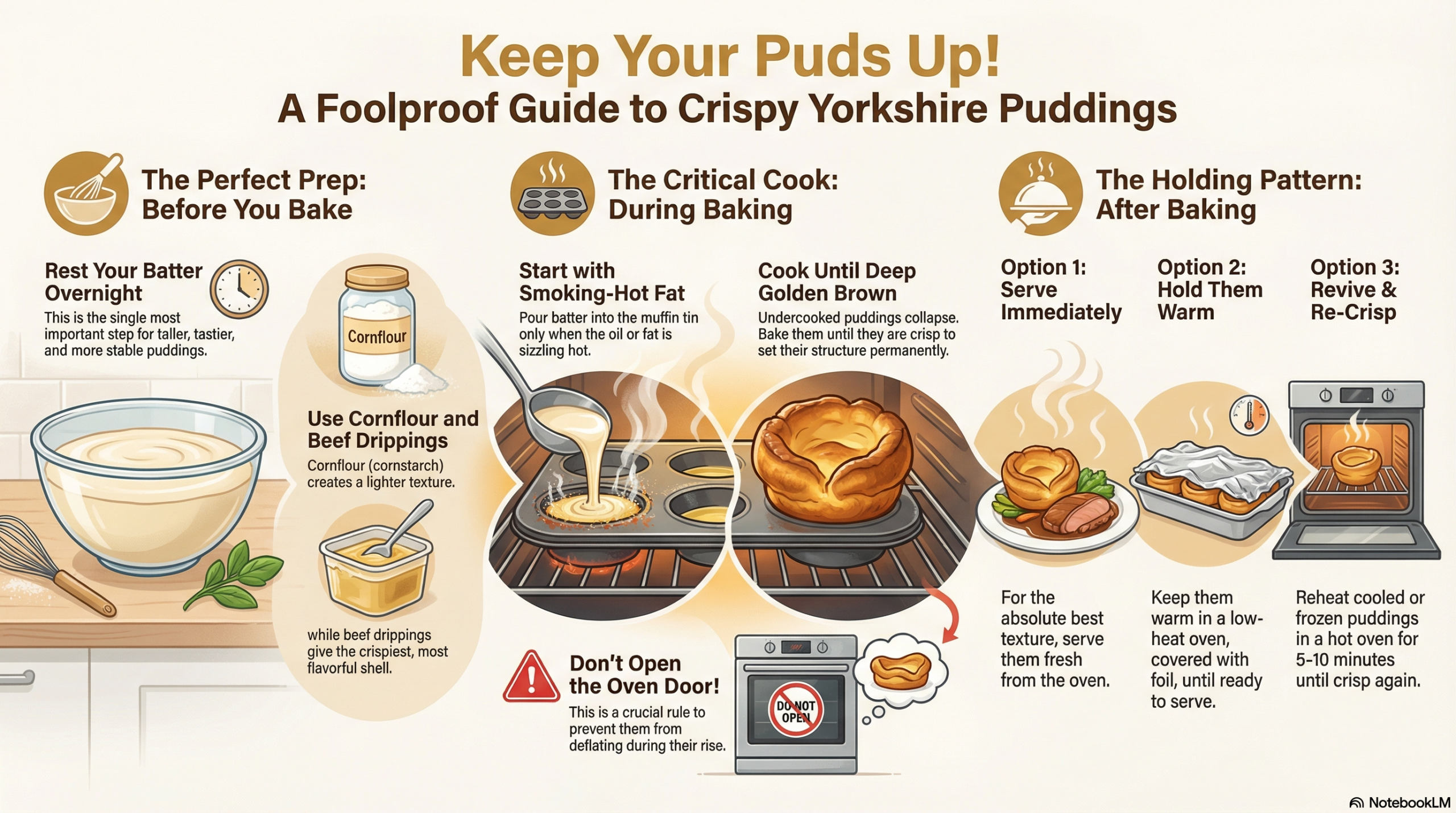
The secret to a Yorkshire pudding that holds well begins with the initial bake. A robust, well-baked pudding is far more likely to stay crisp than one that is rushed or undercooked. Focus on these key principles for a solid foundation.
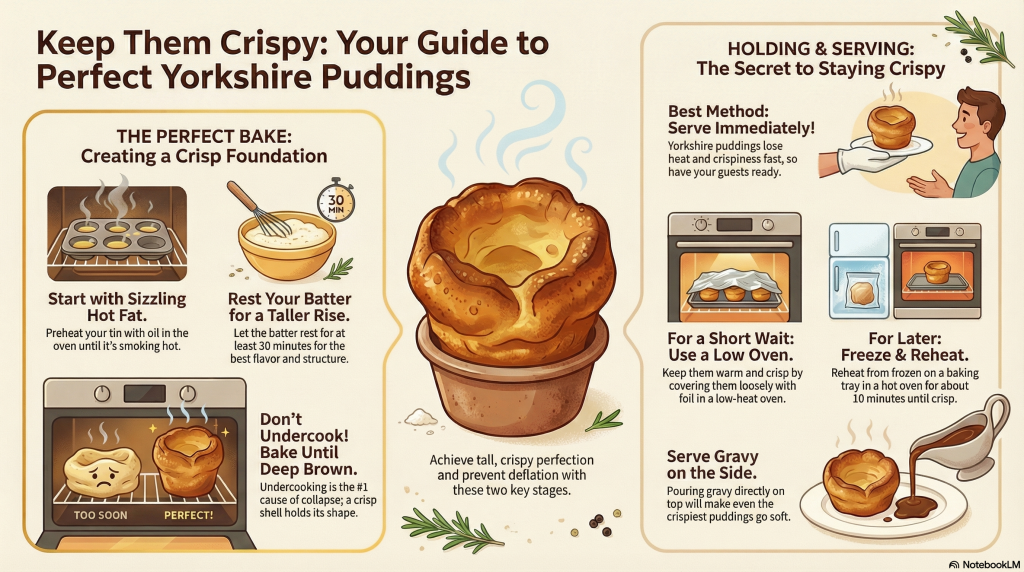
• Heat is Everything: The single most important factor for a good rise is heat. Your oven, muffin tin or dedicated Yorkshire pudding tin, and the fat within it must be what one recipe calls “smoking HOT” before the batter is added. This initial blast of intense heat makes the batter puff up immediately. For the crispiest, most flavourful results, use a saturated fat like beef drippings. While pre-heating is essential for traditional heavy pans, Kenji López-Alt notes it is less critical for modern, thin muffin tins which heat up almost instantly.
• Don’t Undercook: If your puddings sink and deflate the second you pull them from the oven, they are very likely undercooked. According to Becky Excell’s recipe, they need to bake until they are “nice and golden and crisp,” which sets their shape and ensures the structure is strong enough to hold. A pale pudding is an unstable one.
• Rest Your Batter: The Single Most Important Step: Contrary to many recipes that suggest you can bake immediately, extensive testing by J. Kenji López-Alt has shown that resting the batter is the number one factor for achieving a taller, tastier pudding. An overnight rest allows enzymes to break down proteins and starches, resulting in a superior, stretchier texture with large bubbles—perfect for holding gravy. Even the temperature of your rested batter can be used to your advantage: warmer batter produces a taller, more hollow pudding, while colder batter creates a better “cup” shape for holding sauces.
Short-Term Solutions: Keeping Yorkshires Ready for Dinner
Let’s be clear: a Yorkshire pudding “waits for no one.” As J. Kenji López-Alt notes, they “lose heat fast.” The best-laid plans for a Sunday roast demand that the puddings are the last thing out of the oven.
However, if you’re in a bind and only need to keep them warm for 15 minutes while you carve the joint, there is a straightforward method. The puddings “can be kept warm until needed by covering with tin foil and placing into an oven at low heat.” Be aware of the trade-off, though. Covering the puddings with foil will trap some of that escaping steam, which can slightly soften that perfect crisp exterior. This method prioritises warmth over ultimate texture and, while a useful trick at a push, is not the ideal solution for long-term crispness.
The Make-Ahead Masterplan: How to Store and Reheat for Perfect Crispness
For a truly stress-free Sunday lunch and guaranteed crispy results, the best solution is to bake your Yorkshire puddings in advance. By allowing them to cool completely, you let all that internal steam—the enemy of crispness—escape before storage. You can then store them and reheat them just before serving, driving off any surface moisture and returning them to their former crispy glory.
1. The Refrigerator Method (Up to 5 Days)
This method is ideal if you’re preparing your puddings a day or two before your meal.
1. Cool Down: Once baked, let the Yorkshire puddings cool completely on a wire rack. This step is crucial to prevent condensation from forming during storage.
2. Store: Place the cooled puddings in the fridge, covered with clingfilm, for up to five days.
3. Re-Crisp: When you’re ready to serve, place the puddings on a baking tray and warm them in a pre-heated oven for about 5 minutes, or “until crisp again.”
2. The Freezer Method (Up to 3 Months)
For the ultimate in convenience, freezing is the superior long-term strategy. This allows you to have perfect puddings on hand for weeks or even months.
1. Bake and Cool Completely: As with the refrigerator method, you must let the puddings cool fully before they go anywhere near the freezer.
2. Freeze for Freshness: Place the completely cooled puddings into a freezer-safe, ziplock bag. They can be frozen for up to two to three months.
3. Reheat from Frozen: Do not thaw the puddings. Reheat them directly from frozen by placing them on a baking tray in a preheated oven at 220°C / 425°F. Bake for 10-20 minutes, or until they are piping hot and perfectly crisp. For smaller batches, a “hot toaster oven” also works wonderfully.
Common Pitfalls: Mistakes That Lead to Soft Puds
To ensure success, avoid these common errors that introduce moisture and ruin your hard-won crispiness.
• Freezing them while still warm. This traps steam inside the bag, which will form ice crystals and make the puddings soggy when reheated.
• Storing them in a sealed container before they are completely cool. Just like freezing them warm, this traps moisture from steam, which will immediately soften the exterior.
• Attempting to reheat them in a microwave. A microwave heats using steam, which is the direct enemy of crispiness. The oven’s dry heat is essential to re-crisp the puddings properly.
• Fussing About the Oven Door. It’s one of the great myths of British cooking, but as J. Kenji López-Alt’s testing confirms, opening the oven door while your Yorkshires are baking will not cause them to collapse. While you don’t want to leave the door open for ages, a quick peek or rotation of the tin is perfectly fine.
Conclusion: The Secret to Perfect, Stress-Free Yorkshire Puddings
Used daily at Teal Farm Pub, Washington NE38
The Pub Command Centre handles everything in this article — without a spreadsheet.
Wet GP%, dry GP%, labour costs, beer line cleaning logs (12 lines), HACCP temperature checks, stock ordering, weekly P&L. All in one system. Used every shift at Teal Farm where labour runs at 15.1% against a UK pub average of 25-30%.
On a pub taking £900k a year, running labour at 15% instead of 25% is worth roughly £90,000. That is what tracking it daily — every shift, every week — actually looks like.
£97 once. No subscription. No monthly fee. Works on any phone, tablet or laptop. Setup under 10 minutes. Built and used by a Marston’s CRP licensee with a 5-star EHO rating and 180 covers.
See the Pub Command Centre — £97 →One-off payment. Works on any device. Used by a working licensee, not a software company that’s never pulled a pint.
📊 Your EPOS tells you what sold. Pub Command Centre tells you whether you made money.
Real-time labour %, cash position and VAT liability in one dashboard. Built by a working pub landlord. £97 once, no monthly fees. 30-day money-back guarantee.
Get Pub Command Centre — £97 →Frequently Asked Questions
Q: How long can you hold Yorkshire puddings without them going soft?
A: Keep them in a warm place at 60-70 degrees C and they will stay crispy for 20-30 minutes maximum. Beyond that, they start absorbing moisture and lose their crunch no matter what you do. For a busy Sunday service, cook in batches and coordinate with your kitchen so they hit plates fresh.
Q: What is the best way to store made Yorkshire puddings?
A: Store cooked puddings on a wire rack uncovered so air circulates and prevents steam from softening them. Keep them in a warm, dry place away from the stove steam. Never stack them or cover them with a plate or foil, as that traps moisture and ruins the texture in minutes.
Q: Can you reheat Yorkshire puddings?
A: Yes, pop them back in a 180 degree C oven for 3-5 minutes just before service to restore crispness. This works better than trying to hold them warm the whole time. Make your puddings in batches, reheat just before plating, and you will get consistently crispy results all service long.
Q: Should I make them earlier in the day for Sunday lunch service?
A: No, that is a recipe for soggy puddings. Make them 30 minutes maximum before service, or prepare the batter earlier and cook them to order in batches. Your customers will appreciate proper crispy puddings over convenience.
Q: What temperature should the oil be for the best results?
A: Get your oil to 200-220 degrees C, hot enough to make them rise and crisp immediately. Anything cooler and they absorb oil and stay heavy; too hot and they burn outside before cooking inside. Use a thermometer initially, then you will learn to judge by feel.
The best way to “hold” a Yorkshire pudding isn’t to hold it at all, but to bake it ahead. By preparing your puddings in advance, letting them cool completely, and then freezing them, you remove all the last-minute timing and guesswork from the equation. A quick reheat in a hot oven just before the dinner bell rings is all it takes to produce Yorkshire puddings that are flawlessly crisp, tall, and ready for gravy. This method not only guarantees a perfect result every time but also removes one of the most stressful elements from the Sunday roast, leaving you more time to enjoy the meal with your family.
Want to increase your Sunday roast profits
Running your pub on gut feel?
The Pub Command Centre gives you wet GP%, cellar checks, staff cost and weekly P&L — from your phone, every shift. £97 once. No subscription.
See the Pub Command Centre →