Finding funding for your pub business shouldn’t feel like searching for buried treasure. Whether you’re opening a community pub, refurbishing an existing venue, or expanding your operations, grant funding can provide the capital you need without diluting ownership or taking on crushing debt.
After helping hundreds of pub landlords through SmartPubTools and securing funding for my own venue, I’ve learned that grant success isn’t about luck—it’s about knowing which opportunities exist, understanding what funders actually want, and crafting applications that demonstrate genuine impact.
This guide provides a curated list of every major grant programme available to UK pub businesses in 2025, plus the insider tips that separate successful applications from rejected ones.
Why Grants Matter for Pub Businesses
The traditional funding route—bank loans and commercial mortgages—has become increasingly difficult for pub operators. Banks view hospitality as high-risk, particularly post-COVID, and many landlords find themselves declined or offered punishing interest rates.
Grants offer three critical advantages:
No repayment required: Unlike loans, grants don’t create monthly obligations that drain cash flow during quiet trading periods.
Validation of your concept: Receiving a competitive grant signals to other investors, suppliers, and customers that independent experts believe in your business model.
Access to support networks: Many grant programmes include mentoring, training, and networking opportunities worth more than the money itself.
The UK grant landscape for pubs has never been stronger. Between community ownership programmes, rural development funds, hospitality recovery schemes, and environmental initiatives, there’s literally hundreds of millions of pounds available—if you know where to look and how to apply.
Understanding Grant Types and Eligibility
Not all grants suit all pub businesses. Understanding the landscape helps you target applications effectively rather than wasting time on unsuitable schemes.
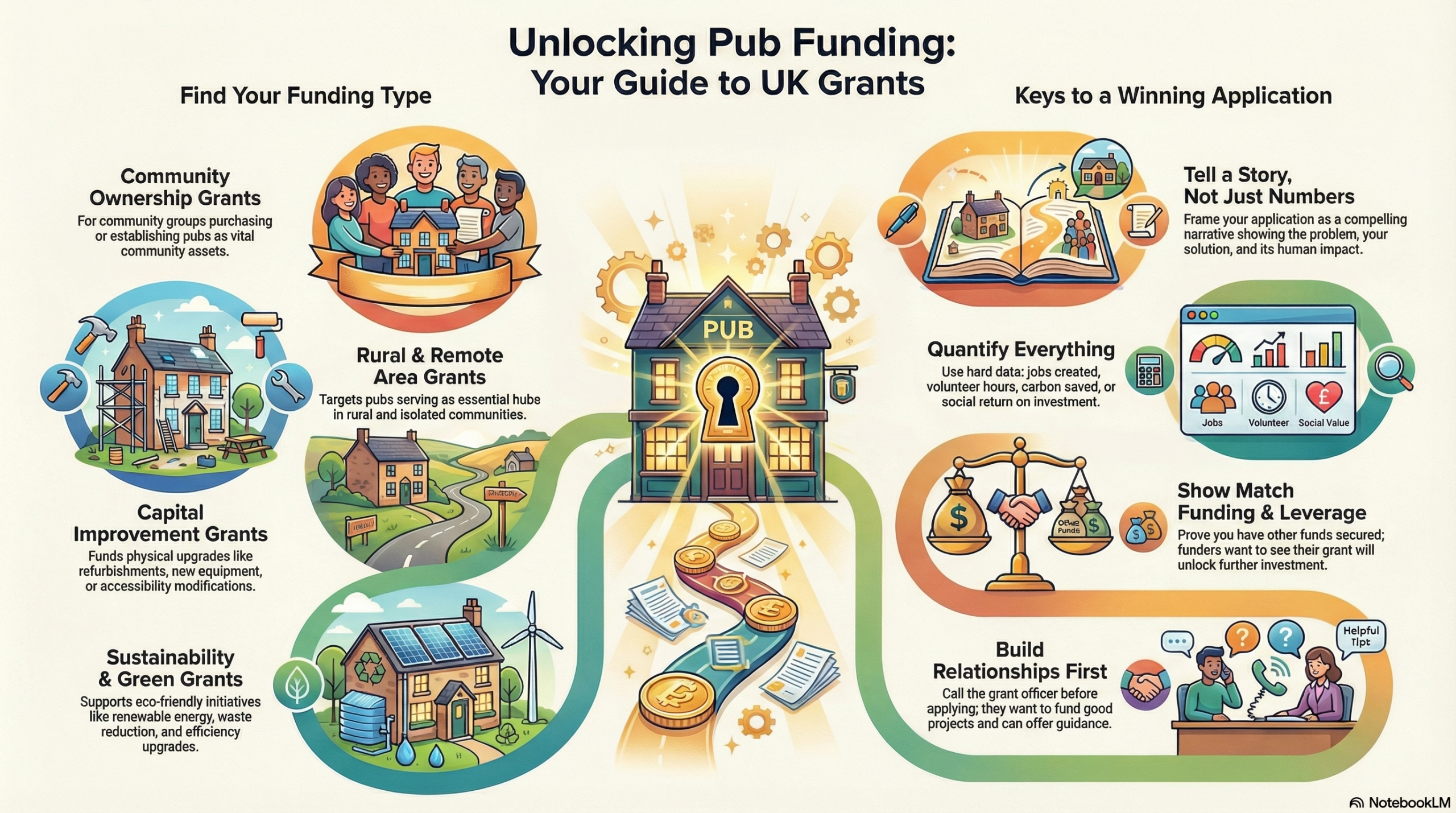
Community Ownership Grants
These fund community groups purchasing or establishing pubs as community assets. Typically require:
- Community Benefit Society or similar legal structure
- Demonstrated community need and support
- Volunteer governance structure
- Community share offer alongside grant funding
Best for: Community groups saving closing pubs or establishing new community-owned venues.
Capital Improvement Grants
Fund physical improvements—refurbishments, equipment purchases, accessibility modifications, energy efficiency upgrades.
Best for: Existing operators investing in their venues to improve customer experience or operational efficiency.
Rural and Remote Area Grants
Specifically target businesses in rural communities, recognizing pubs’ vital role in isolated areas.
Best for: Village pubs, rural gastropubs, and venues serving communities with limited alternative amenities.
Sustainability and Environmental Grants
Fund green initiatives—renewable energy, waste reduction, sustainable sourcing, environmental improvements.
Best for: Operators implementing significant environmental improvements or operating in protected landscapes.
Business Development and Innovation Grants
Support new products, services, technology adoption, staff training, and market expansion.
Best for: Established pubs diversifying revenue streams or implementing innovative business models.
Heritage and Conservation Grants
Preserve historic buildings and maintain traditional pub culture.
Best for: Listed buildings, historically significant venues, and pubs maintaining traditional crafts or cultural practices.
Major Grant Programmes for Pub Businesses
1. More Than a Pub Programme (Plunkett Foundation)
Grant Amount: Up to £100,000 Who Can Apply: Community groups establishing or purchasing community-owned pubs What It Funds: Capital costs, refurbishment, equipment, professional fees Application Deadlines: Rolling programme with quarterly decision rounds Success Rate: Approximately 60% of applications funded
The flagship programme for community pub ownership. Since 2017, More Than a Pub has supported over 150 community pubs with £15 million in funding.
Eligibility Requirements:
- Registered Community Benefit Society (or applying for registration)
- Demonstrated community need through surveys or consultations
- Business plan showing financial sustainability
- Community share offer raising substantial matched funding
- Management committee with relevant expertise
Application Tips:
- Focus on community impact metrics, not just financial projections
- Show how the pub addresses specific local needs (social isolation, meeting space, local employment)
- Demonstrate broad community support through survey data, petition signatures, meeting attendance
- Include letters of support from parish councils, local MPs, community groups
- Be realistic about timelines—rushed applications rarely succeed
- Use Plunkett’s free advisors throughout the process
Common Rejection Reasons:
- Insufficient evidence of community demand
- Weak financial projections showing unsustainable business model
- Inadequate matched funding from community shares
- Poor governance structures or inexperienced management committees
Recent Success Example: The Fox & Hounds in Cheshire received £75,000 after demonstrating their village (population 800) had no other social venue within 3 miles. Their detailed business plan showed how incorporating a post office and community shop would ensure financial viability.
2. Power to Change Community Business Fund
Grant Amount: £50,000 to £600,000 Who Can Apply: Community businesses trading for at least 12 months What It Funds: Growth initiatives, capital investments, income diversification Application Deadlines: Check website for current rounds (typically 2-3 annually) Success Rate: Approximately 25-30% of applications funded
Power to Change focuses on established community businesses ready to scale or significantly develop their operations.
Eligibility Requirements:
- Trading as a community business for minimum 12 months
- At least 51% community ownership
- Clear social mission alongside commercial sustainability
- Demonstrated track record and financial viability
- Specific growth or development project with measurable outcomes
Application Tips:
- This isn’t startup funding—demonstrate established success before seeking growth capital
- Focus your application on one specific project, not general operational support
- Show how the investment creates systemic change, not just incremental improvement
- Include clear social value metrics (Social Return on Investment calculations strengthen applications)
- Budget for development support costs—Power to Change values professional implementation
- Allow 3-6 months for the full application process
What They Fund Well:
- Accommodation additions generating new revenue streams
- Kitchen expansions enabling external catering businesses
- Meeting room developments creating hire revenue
- Technology investments improving operational efficiency
- Staff training programmes building long-term capacity
What They Don’t Fund:
- General operating costs or debt refinancing
- Projects without clear community benefit
- Businesses in their first year of operation
- Applications where grant is primarily benefiting private owners
3. Pub is The Hub Grant Scheme
Grant Amount: Up to £50,000 (£100,000 in exceptional cases) Who Can Apply: Rural pubs diversifying into community services What It Funds: Conversion costs for integrating services like post offices, shops, meeting rooms, IT facilities Application Deadlines: Rolling programme Success Rate: Approximately 40-50% of applications funded
Specifically designed to help rural pubs survive by diversifying beyond traditional pub operations.
Eligibility Requirements:
- Located in rural community (typically population under 3,000)
- Introducing new community service not currently available locally
- Demonstrated community need for the proposed service
- Landlord/owner support and appropriate lease terms
Application Tips:
- Start with community consultation—surveys and public meetings provide essential evidence
- Secure commitment letters from service partners (Post Office, library services, etc.) before applying
- Demonstrate the service fills a genuine gap—if there’s a shop 200 yards away, you won’t get funded
- Show how the additional footfall benefits the core pub business
- Include realistic revenue projections for the new service
- Address practical concerns (separate entrance for different opening hours, distinct service areas)
Funded Services Include:
- Post Office counters
- Community shops selling basics and local produce
- Meeting rooms and co-working spaces
- IT hubs providing internet access
- Health service satellite provision (pharmacy collections, nurse consultations)
- Tourist information points
- Library service access points
Recent Success Example: The Crown in Lincolnshire received £38,000 to install a post office and community shop. The grant covered partition walls, refrigeration equipment, and post office counter systems. Revenue from the services added £18,000 annually while increasing pub footfall by 35%.
4. Rural Development Programme for England (RDPE)
Grant Amount: Varies by local authority, typically 40-60% of project costs up to £50,000 Who Can Apply: Rural businesses and community organizations What It Funds: Business development, job creation, rural services, environmental improvements Application Deadlines: Varies by Local Enterprise Partnership area Success Rate: Approximately 30-40% of applications funded
RDPE funding operates through Local Enterprise Partnerships (LEPs), so availability and focus areas vary significantly by region.
Eligibility Requirements:
- Located in rural area (definitions vary by LEP)
- Business must create or safeguard local jobs
- Project demonstrates rural economic or community benefit
- Match funding secured (typically 40-60% of project costs)
- Planning permissions and other consents obtained
Application Tips:
- Contact your LEP’s growth hub BEFORE starting your application—they provide free support
- Focus heavily on job creation and economic impact—these are primary decision criteria
- Include employment projections with credible calculations (e.g., “kitchen expansion enables lunch service, requiring 2 additional FTE kitchen staff”)
- Environmental benefits strengthen applications—renewable energy, habitat improvements, sustainable sourcing
- Application complexity varies dramatically by LEP—some require detailed feasibility studies, others accept simpler formats
- Processing times range from 3-9 months depending on LEP efficiency
What Gets Funded:
- Kitchen equipment enabling food service expansion
- Accommodation development creating tourism employment
- Renewable energy installations reducing operating costs
- Accessibility improvements expanding customer base
- Garden and outdoor space developments extending trading capacity
Regional Variations:
- Some LEPs prioritize tourism businesses
- Others focus on community services
- A few restrict funding to businesses serving specific disadvantaged communities
- Check your specific LEP’s current priorities before investing application time
5. UK Hospitality Recovery and Growth Fund
Grant Amount: £10,000 to £50,000 Who Can Apply: Independent hospitality businesses affected by COVID-19 disruptions What It Funds: Business recovery, adaptation, and growth initiatives Application Deadlines: Check UK Hospitality website for current availability Success Rate: Approximately 35% of applications funded
This programme specifically addresses ongoing COVID-19 impacts and helps businesses adapt to changed consumer behaviors.
Eligibility Requirements:
- Independent operator (not chains or corporate venues)
- Demonstrated significant revenue impact from COVID-19
- Clear recovery or adaptation plan
- UK Hospitality membership (individual or regional hospitality association)
- Business viability outside of grant funding
Application Tips:
- Quantify COVID impact specifically—percentage revenue decline, specific trading restrictions faced
- Show how consumer behavior has permanently changed in your market
- Explain how the grant enables adaptation to new realities (outdoor space, delivery infrastructure, event hosting capabilities)
- Include customer research or data showing demand for your proposed improvements
- Demonstrate you’ve already taken preliminary recovery steps—this isn’t bailout funding for passive operators
Funded Projects:
- Outdoor trading area development (covered terraces, heating, lighting)
- Kitchen equipment for delivery and takeaway services
- Event technology (sound systems, lighting) for increased entertainment offerings
- Booking and payment systems reducing contact and improving efficiency
- Marketing campaigns rebuilding local customer base
6. Community Shares Booster Programme
Grant Amount: Up to £100,000 (as matched funding) Who Can Apply: Community businesses raising capital through community share offers What It Funds: Matched funding for community share offers on 1:1 or 2:1 basis Application Deadlines: Rolling programme Success Rate: Approximately 45-50% of applications receive boost
This innovative programme multiplies the impact of community share fundraising by matching member investments.
Eligibility Requirements:
- Community Benefit Society or Co-operative Society
- Approved share offer under FCA regulations
- Minimum £50,000 share offer target
- Business plan showing long-term sustainability
- Project creates or preserves community assets
Application Tips:
- Apply BEFORE launching your share offer—retroactive applications aren’t accepted
- The boost significantly improves share offer success rates—market it prominently
- Structure your share offer to maximize the boost (e.g., if you need £150,000 total, target £100,000 from shares plus £50,000 boost)
- Combine with other grants—Booster Programme explicitly allows combining with More Than a Pub and other funding
- Use the boost as a marketing tool: “Every £2 you invest becomes £3 with matched funding”
How It Works:
- You raise £100,000 through community shares
- Booster Programme provides £50,000 matched funding
- Your total capital becomes £150,000
- Matched funding isn’t technically a grant—it’s invested as shares, but with no expectation of dividends or returns
7. Historic England Heritage Action Zones
Grant Amount: Up to £25,000 for feasibility studies; up to £250,000 for implementation Who Can Apply: Owners and operators of heritage buildings in designated Heritage Action Zones What It Funds: Building conservation, restoration, and heritage-sensitive improvements Application Deadlines: Varies by HAZ area Success Rate: Approximately 50-60% of eligible applications funded
If your pub is a listed building or in a designated Heritage Action Zone, this programme provides substantial funding for appropriate conservation work.
Eligibility Requirements:
- Building located in designated Heritage Action Zone
- Works must preserve or enhance heritage significance
- Listed Building Consent obtained (where applicable)
- Conservation architect or specialist contractor engaged
- Compliance with Historic England technical guidance
Application Tips:
- Engage a conservation architect early—their expertise is essential and Historic England knows the good ones
- Use traditional materials and methods—modern equivalents rarely qualify even if cheaper
- Document existing condition thoroughly with photos and reports
- Frame your application around preserving heritage for future generations, not just improving your business
- Allow significant time for listed building consent before starting work
- Budget realistically—heritage work costs 30-50% more than standard refurbishment
Funded Works Include:
- Roof repairs using traditional materials
- Window restoration and repair (not replacement)
- Stonework and brickwork conservation
- Historic signage restoration
- Historically appropriate lighting installations
- Removal of inappropriate modern additions
What Doesn’t Get Funded:
- UPVC windows or modern materials
- Internal modernization without heritage significance
- Work that damages historic fabric
- Projects lacking proper professional guidance
8. Arts Council England Grants for the Arts
Grant Amount: £1,000 to £100,000 Who Can Apply: Arts organizations and individuals, including pubs hosting regular arts events What It Funds: Arts programming, equipment, artist fees, venue improvements supporting arts Application Deadlines: Rolling programme Success Rate: Approximately 45% of applications funded
If your pub positions as a live music venue, theater space, or arts hub, Arts Council funding can support programming and development.
Eligibility Requirements:
- Regular arts programming (weekly/monthly events)
- Quality arts offering with professional artists
- Clear artistic vision and audience development strategy
- Appropriate facilities for arts presentation
- Financial viability of the venue
Application Tips:
- This funds ARTS activity, not general pub operations—keep applications focused on artistic provision
- Demonstrate your venue’s unique role in local arts ecology—what artistic opportunities would disappear without you?
- Include artist letters of support and audience testimonials
- Show how your arts programme develops audiences and participates in broader cultural conversations
- Budget for proper artist fees—Arts Council scrutinizes whether artists are fairly compensated
- Activity plans should span 12-24 months, not single events
Fundable Activities:
- Live music series featuring emerging artists
- Comedy club development programmes
- Theater productions and rehearsed readings
- Literary events and spoken word nights
- Art exhibitions in pub spaces
- Sound and lighting equipment for performance
- Acoustic improvements for live music
9. Crowdfunder Community Funds (Multiple Local Authorities)
Grant Amount: Typically £250 to £5,000 matched funding Who Can Apply: Community projects running crowdfunding campaigns What It Funds: Community benefit projects with matched crowdfunding contributions Application Deadlines: Varies by local authority Success Rate: 70-80% of campaigns reaching targets receive matched funding
Many local authorities operate matched crowdfunding schemes where they’ll match funds raised by communities for projects delivering local benefit.
Eligibility Requirements:
- Located in participating local authority area
- Clear community benefit demonstrated
- Crowdfunding campaign target between £500-£10,000 typically
- Project ready for implementation within 6-12 months
Application Tips:
- Start with your local authority’s community development team—they’ll guide you through available schemes
- Set realistic crowdfunding targets—better to exceed a modest goal than fail at an ambitious one
- Create compelling campaign videos and images—crowdfunding succeeds on storytelling
- Offer meaningful rewards/perks to backers (meals, event tickets, recognition)
- Build momentum early—campaigns raising 30% in the first week are 3x more likely to succeed
- Leverage your shareholder/customer email list before launching publicly
Successful Project Types:
- Beer garden improvements
- Play equipment for family areas
- Accessibility modifications
- Community events and festivals
- Arts and culture programming
- Sports equipment or facilities
10. National Lottery Heritage Fund
Grant Amount: £10,000 to £5 million Who Can Apply: Organizations preserving heritage (architectural, social, cultural) What It Funds: Heritage preservation, interpretation, community engagement Application Deadlines: Rolling programme with different schemes Success Rate: Approximately 50-60% for grants under £100,000
If your pub has significant heritage value—architecturally, historically, or as a community asset—Heritage Fund can support preservation and interpretation.
Eligibility Requirements:
- Clear heritage significance (architectural, cultural, historical)
- Project benefits people and heritage
- Heritage will be better managed and in better condition
- More people will engage with heritage
- Broader public benefit demonstrated
Application Tips:
- Heritage isn’t just old buildings—social history, brewing heritage, cultural significance all qualify
- Create interpretation materials helping visitors understand your pub’s heritage
- Include community participation activities (heritage talks, historical research groups, oral history collection)
- Conservation plans strengthen applications for architectural projects
- Show how heritage preservation contributes to broader community wellbeing
- Smaller grants (under £50,000) have simpler applications—start here if you’re new to Heritage Fund
Fundable Activities:
- Building conservation and restoration
- Heritage interpretation (displays, information panels, digital resources)
- Oral history projects capturing pub’s social history
- Archaeological investigation of historic pub sites
- Heritage skills training (traditional pub games, brewing history)
- Community archive creation
11. Green Business Fund (Various Regional Programmes)
Grant Amount: £1,000 to £50,000 Who Can Apply: Businesses implementing environmental improvements What It Funds: Energy efficiency, renewable energy, waste reduction, sustainable transport Application Deadlines: Varies by regional programme Success Rate: Approximately 55% of applications funded
Multiple regional programmes support businesses reducing environmental impact while cutting operating costs.
Eligibility Requirements:
- Businesses in specific regions (availability varies)
- Projects reducing carbon emissions or environmental impact
- Carbon savings quantified and verified
- Professional assessment of proposed measures
- Match funding typically required (20-50% of costs)
Application Tips:
- Start with free energy audits offered by many programmes—they identify fundable opportunities
- Quantify savings in both environmental and financial terms
- Combine multiple measures in one application (lighting, heating, insulation) for better economics
- Include monitoring and verification plans showing actual savings achieved
- Renewable energy (solar, heat pumps) typically receives priority over efficiency measures alone
- Some programmes require accredited installers—check before committing to contractors
Funded Improvements:
- LED lighting upgrades across venue
- Smart heating controls and zone management
- Insulation improvements (roof, walls, windows)
- Solar PV installations
- Air source or ground source heat pumps
- Water efficiency measures
- Electric vehicle charging points
- Refrigeration efficiency upgrades
Typical Payback: Many funded improvements save £2,000-8,000 annually on utilities, with grants covering 40-60% of installation costs.
12. Football Foundation Funding
Grant Amount: Up to £50,000 Who Can Apply: Community facilities providing football and sports activities What It Funds: Facility improvements supporting grassroots football Application Deadlines: Rolling programme Success Rate: Approximately 40% of applications funded
If your pub has facilities used by local football teams or could develop such facilities, Football Foundation provides substantial support.
Eligibility Requirements:
- Facility used by local football teams or clubs
- Clear participation targets showing increased football activity
- Commitment to FA coaching standards and inclusion policies
- Security of tenure (ownership or minimum 25-year lease)
- Planning permissions for development
Application Tips:
- Partner with local football clubs who’ll use facilities—their support letters are essential
- Quantify participation increases: “Will enable Under-11s girls team to train locally (currently travel 8 miles), adding 35 participants weekly”
- Include disability football and women’s football—these are Foundation priorities
- Show how improvements benefit broader community beyond football
- Facility improvements must meet FA standards—consult FA Facilities team before designing projects
Fundable Projects:
- Changing room construction or refurbishment
- Floodlighting for evening training
- Pitch improvements or artificial surfaces
- Equipment storage facilities
- Spectator shelters
- Disability access improvements
13. Rural Community Energy Fund
Grant Amount: Feasibility studies up to £40,000; implementation up to £130,000 Who Can Apply: Rural communities developing renewable energy projects What It Funds: Community renewable energy feasibility and development Application Deadlines: Check programme website for current rounds Success Rate: Approximately 45% of feasibility applications progress to implementation
Rural pubs with suitable sites can develop community renewable energy projects generating income while reducing carbon emissions.
Eligibility Requirements:
- Located in rural area
- Community organization structure (Community Benefit Society ideal)
- Renewable energy project viable on site (solar, wind, hydro)
- Community engagement and support
- Technical feasibility demonstrated
Application Tips:
- Start with feasibility funding—it covers professional assessments determining if projects are viable
- Roof-mounted solar is most common for pub buildings
- Ground-mounted solar works if you have adjacent land
- Consider community ownership model where local residents invest alongside your organization
- Revenue from excess generation (exported to grid) can fund community activities
- Combine with Green Business Funds for maximum impact
Project Examples:
- 50kW solar array providing pub electricity plus grid export revenue
- Community hydro scheme using nearby water course
- Ground-mounted solar on pub-owned land creating income stream
14. Town Centre Recovery Funds (Various Local Authorities)
Grant Amount: £5,000 to £50,000 Who Can Apply: Town centre businesses supporting high street recovery What It Funds: Shopfront improvements, accessibility, outdoor trading, technology Application Deadlines: Varies by local authority Success Rate: Approximately 50-60% of applications funded
Many local authorities operate grants helping town centre businesses adapt and improve, particularly supporting outdoor dining and street appeal.
Eligibility Requirements:
- Located in designated town centre area
- Improvements visible and benefiting streetscape
- Business viability demonstrated
- Planning permissions secured where required
- Match funding (typically 30-50% of costs)
Application Tips:
- Frame applications around improving broader town centre appeal, not just your business
- Outdoor seating and dining areas receive priority—they create street vitality
- Include before/after visualizations showing improvement
- Coordinate with neighboring businesses for combined impact
- Consult conservation officers early if in conservation area
- Some authorities require licensed premises to participate in Best Bar None scheme
Funded Improvements:
- Outdoor seating and dining infrastructure
- Façade improvements and repainting
- Signage upgrades
- Accessibility ramps and automatic doors
- Lighting improvements
- Security measures (CCTV, shutters)
- Pavement furniture (planters, barriers)
15. Levelling Up Fund
Grant Amount: £20 million to £50 million (for area-wide programmes) Who Can Apply: Local authorities bidding for area regeneration What It Funds: Town centre regeneration, transport, culture, and heritage Application Deadlines: Government announces bidding rounds Success Rate: Approximately 30% of local authority bids successful
While pubs don’t apply directly, you can benefit from area-wide programmes if you’re in targeted regeneration areas.
How to Benefit:
- Engage with your local authority’s economic development team about upcoming bids
- Offer to be a case study demonstrating need for area regeneration
- Ensure your business appears in area assessments and consultations
- Once funding secured for area programmes, apply for individual grants from the regeneration programme
- Position your pub as anchor tenant in regeneration plans
Typical Funded Elements:
- Public realm improvements around venues
- Heritage building restoration grants
- Business support programmes
- Skills and training initiatives
- Cultural programming support
Sector-Specific and Trade Body Grants
16. CAMRA Pub Preservation Grants
Grant Amount: Up to £5,000 Who Can Apply: Pubs preserving historic pub interiors and traditional features What It Funds: Conservation of nationally important pub interiors Application Deadlines: Annual or biannual rounds
17. SIBA Members’ Development Grants
Grant Amount: Varies Who Can Apply: SIBA member breweries and brewery tap rooms What It Funds: Equipment, training, export development Application Deadlines: Check SIBA website
18. Brewers’ Benevolent Fund
Grant Amount: Discretionary Who Can Apply: Individuals in brewing and pub trade facing hardship What It Funds: Personal financial assistance, not business grants
19. Licensed Trade Charity
Grant Amount: Varies Who Can Apply: Hospitality workers and families facing hardship What It Funds: Personal welfare support, retraining, health needs
Regional and Local Grant Programmes
Beyond national schemes, hundreds of regional and local grant programmes exist. Research these through:
Local Authority Economic Development Grants
Most councils operate small business grant schemes (£1,000-£10,000) for businesses creating jobs or improving high streets. Contact your council’s business support team.
Local Enterprise Partnerships (LEPs)
Each LEP operates different schemes. Access through their Growth Hub service offering free business support and grant signposting.
County Council Rural Grants
Many county councils operate specific rural business support programmes separate from RDPE.
Parish Council Community Grants
Surprisingly, parish councils often have £500-£3,000 grants for community benefit projects—don’t overlook these small pots that add up.
Local Trust Foundations
Community foundations, charitable trusts, and local philanthropic organizations in your area may fund community pubs or hospitality businesses with community benefit.
Grant Application Success Strategies
After reviewing hundreds of grant applications and writing dozens that succeeded, I’ve identified patterns separating successful applications from failures.
Strategy 1: Start with Relationships, Not Applications
The biggest mistake is treating grant applications as transactional forms you submit. Successful applicants build relationships with grant officers before applying.
Do this:
- Call the programme officer before starting your application
- Attend webinars and information sessions
- Ask if they’ll review a draft outline before full submission
- Visit their office or request a site visit to your pub
- Join peer networks of previous grant recipients
Grant officers want to fund good projects. They’ll guide you toward strong applications if you engage early.
Strategy 2: Tell Stories, Not Just Numbers
Financial projections matter, but grants are judged by humans who respond to compelling narratives.
Structure your narrative:
- The challenge: Paint the picture of what’s wrong or missing
- Your solution: Explain specifically how the grant will solve it
- The impact: Show who benefits and how their lives improve
- The evidence: Data proving your solution works
Example: “High Greens’ 340 residents over 65 face increasing isolation. The pub’s closure removed their last regular gathering place. Mrs. Patterson, 78, now sees neighbors just twice monthly at church, down from daily pub visits. Our community pub will host three weekly senior socials, a monthly lunch club, and daily coffee mornings. Similar programmes at Middleton Community Pub increased older residents’ social contacts by 260% within six months.”
That narrative creates emotional connection while including evidence.
Strategy 3: Quantify Everything Possible
Funders increasingly demand metrics and social value calculations. Develop these before applying:
Jobs: Full-time equivalents (FTE) created or safeguarded Volunteering: Hours contributed and economic value (£15-20/hour) Community benefit: Number of people served, frequency of service, outcomes achieved Carbon reduction: Tonnes of CO2 saved annually Economic impact: Multiplier effect in local economy (hospitality £1 spent generates £1.40-1.60 in local economy) Social return on investment (SROI): Calculate using established methodology
Example: “This £50,000 grant will:
- Create 2.5 FTE paid positions (£52,000 annual wages into local economy)
- Generate 850 volunteer hours annually (£17,000 social value)
- Serve 4,200 customers monthly (50,400 annually)
- Prevent 12 tonnes CO2 annually through renewable energy
- Generate £1:£3.20 social return on investment”
Strategy 4: Demonstrate Match Funding and Leverage
Few grants cover 100% of project costs. Funders want to see you’ve secured match funding, demonstrating:
- Other funders believe in your project
- You have financial resources and management capability
- The grant will leverage additional investment
Strong match funding sources:
- Community share offers
- Other confirmed grants
- Owner equity investment
- Loan finance (secured, not just applied)
- In-kind contributions (volunteer labor, donated materials)
How to present it: “Total project cost: £150,000
- Your grant: £50,000 (33%)
- Community shares: £60,000 (confirmed through share offer)
- More Than a Pub grant: £25,000 (confirmed)
- Owner equity: £15,000 (confirmed) This creates £3 of investment for every £1 of your funding.”
Strategy 5: Show Sustainability Beyond the Grant
Funders don’t want to fund businesses that collapse once grant money runs out. Demonstrate long-term viability:
Include:
- Three-year financial projections showing growth and profitability
- Diversified revenue streams reducing risk
- Management expertise and succession planning
- Reserves policy for handling challenges
- Ongoing fundraising strategy for future development
Example: “Year 1 revenue: £280,000 (60% wet sales, 35% food, 5% other) Year 3 revenue: £385,000 (50% wet sales, 40% food, 10% other) This diversification reduces dependence on any single revenue stream. Projected reserves by Year 3: £45,000 (4 months operating expenses), protecting against seasonal variations and unexpected costs.”
Strategy 6: Address Risks Honestly
Acknowledge challenges and explain mitigation strategies. This demonstrates maturity and preparedness, not weakness.
Format: “Risk: Difficulty recruiting quality chefs in rural area Likelihood: Medium | Impact: High Mitigation: (1) Competitive wages 15% above local average, (2) Accommodation offered, (3) Partnership with local catering college for apprentices, (4) Menu designed for skilled generalist rather than specialist fine dining chef”
Address 4-6 key risks this way, showing you’ve genuinely thought through implementation challenges.
Strategy 7: Use Professional Presentation
Your application quality signals your professionalism and capability.
Do:
- Professional photos of your venue, community, and proposed improvements
- Clear charts and graphs visualizing data
- Consistent formatting throughout
- Proofread thoroughly (errors suggest carelessness)
- Use applicant portal features properly
- Submit before deadline, not last minute
Don’t:
- Submit handwritten applications unless specifically required
- Use unprofessional fonts or excessive formatting
- Include irrelevant information padding word count
- Submit incomplete applications planning to “add details later”
Strategy 8: Budget Realistically with Contingencies
Under-budgeting kills projects. Over-budgeting wastes grant funds and credibility.
Best practice:
- Get three quotes for major costs
- Add 10-15% contingency for unexpected issues
- Include VAT where applicable (depending on your VAT status)
- Budget for professional fees (architects, surveyors, consultants)
- Include equipment maintenance and ongoing costs
- Show realistic revenue assumptions
Example budget line: “Kitchen equipment: £24,000
- Commercial range cooker: £6,500 (based on three supplier quotes)
- Commercial refrigeration: £5,200
- Preparation tables and sinks: £3,800
- Extraction and ventilation: £6,000
- Small equipment and utensils: £2,500
- Contingency (10%): £2,400″
Strategy 9: Leverage Professional Support
Many grant programmes offer free support through:
- Programme advisors who’ll review draft applications
- Business support organizations (Plunkett Foundation, Co-operatives UK, Federation of Small Businesses)
- Local authority business support teams
- Accountants and grant specialists (for larger applications, their fees often qualify as project costs)
Use this support. Advisors see patterns across hundreds of applications and know what works.
Strategy 10: Learn from Rejection
Most applicants face rejection before success. Use it constructively:
Do:
- Request feedback from grant officers
- Ask specifically what would strengthen a resubmission
- Find out if you can apply again and when
- Inquire about alternative programmes you might suit better
- Join networks of other applicants to share learning
Many successful grant recipients applied 2-3 times before funding, using feedback to improve each iteration.
Common Application Mistakes to Avoid
Mistake 1: Applying for Unsuitable Grants
Just because a grant exists doesn’t mean it suits your project. Carefully review eligibility criteria before investing time.
Red flags you’re unsuitable:
- Your project doesn’t match grant priorities
- You don’t meet legal structure requirements
- Your location falls outside eligible areas
- Timeline doesn’t align with grant delivery requirements
Mistake 2: Generic Applications
Cut-and-paste applications from previous submissions or templates rarely succeed. Every application must specifically address that funder’s priorities and assessment criteria.
Mistake 3: Weak Community Consultation
For community-focused grants, saying “everyone wants this” without evidence won’t work. Conduct proper consultation:
- Surveys with statistically relevant sample sizes
- Public meetings with documented attendance
- Letters of support from community organizations
- Petition signatures from verified local residents
- Focus groups providing detailed feedback
Mistake 4: Unrealistic Timelines
“We’ll complete refurbishment in 4 weeks” signals you don’t understand construction reality. Build realistic timelines accounting for:
- Planning permissions (8-16 weeks)
- Listed building consent (12-20 weeks)
- Procurement and competitive tendering (6-8 weeks)
- Construction delays and weather impacts
- Licensing applications or variations
- Staff recruitment and training
Mistake 5: Ignoring Assessment Criteria
Every grant publishes assessment criteria. Successful applications directly address each criterion with specific evidence.
Do this: Structure your application with headings matching their criteria: “Assessment Criterion 3: Demonstrates Community Need Evidence: Our village survey (n=284, 41% response rate) showed:
- 76% would use community pub weekly
- 89% believe village needs social gathering space
- 67% would purchase community shares…”
Mistake 6: Poor Financial Management Evidence
Funders need confidence you’ll manage money responsibly. Strengthen applications with:
- Recent accounts showing financial competence
- Bookkeeping and accounting systems described
- Separation of grant funds from operating funds
- Regular financial reporting commitments
- Named treasurer or finance officer with relevant experience
Mistake 7: Vague Impact Statements
“This will benefit the community” isn’t enough. Specify exactly who benefits and how:
Weak: “The pub will support local jobs” Strong: “The pub will create 2.5 FTE positions (£52,000 payroll) filled by local residents within 5 miles, plus 1 apprenticeship in partnership with Tyneside Catering College”
Weak: “Elderly residents will benefit” Strong: “Weekly Tuesday lunch clubs will serve 25-30 residents over 65, many of whom currently eat lunch alone daily. Participant surveys at comparable venues show 67% reduction in self-reported loneliness after 6 months participation”
Mistake 8: Neglecting Accessibility
Modern grant applications increasingly scrutinize:
- Physical accessibility for disabled visitors
- Economic accessibility (pricing doesn’t exclude lower-income community members)
- Cultural accessibility (welcoming to diverse groups)
- Age accessibility (suitable for all ages)
Address these proactively in applications, showing inclusive design from the start.
Managing Grant Funds Successfully
Receiving grant funding is just the beginning. Proper management ensures compliance and strengthens applications for future funding.
Financial Management
Separate accounting: Use dedicated accounts or accounting codes for grant funds, clearly separating from operational revenue.
Audit trail: Maintain detailed records of every expenditure—invoices, receipts, payment authorizations, and evidence of competitive procurement.
Reporting: Submit required reports promptly with accurate financial information. Late or incomplete reporting damages relationships and future applications.
Underspend/overspend: Contact grant officers immediately if costs vary from budget. Most allow reasonable variation (10-15%) without formal amendments.
Project Delivery
Milestones: Deliver project milestones on schedule. If delays occur, communicate proactively with explanation and revised timeline.
Quality: Don’t cut corners to save money. Funders funded your quality proposal, not a cheap alternative.
Documentation: Photograph every stage (before, during, after). This provides evidence for reports and case studies for future applications.
Community engagement: Keep stakeholders informed throughout. Their ongoing support matters for future initiatives.
Reporting Impact
Most grants require impact reporting 6-12 months post-completion. Make this easier:
Baseline data: Collect metrics BEFORE project starts for comparison Ongoing monitoring: Track relevant metrics monthly, not scrambling at report deadline Stories and testimonials: Collect customer and community feedback continuously Photographs and videos: Document the project and its impact visually
Strong impact reporting leads to case studies, references for future applications, and sometimes additional funding.
Using Technology to Strengthen Applications and Operations
Grant applications increasingly expect professional operational systems. Modern technology demonstrates capability and improves outcomes.
Business Planning and Forecasting Tools
Sophisticated financial projections impress grant assessors. Use proper forecasting software rather than basic spreadsheets.
Marketing and Customer Engagement Systems
Demonstrate how you’ll maintain engagement post-funding. Modern marketing automation shows professional approach.
This is where SmartPubTools provides genuine value for grant applications. When your application describes marketing plans, referencing AI-powered marketing automation designed specifically for UK pubs demonstrates:
- Professional approach to operations
- Understanding of modern hospitality challenges
- Systems for sustainable success beyond grant period
- Commitment to consistent community engagement
Many successful grant recipients use SmartPubTools to implement the marketing and community engagement strategies described in their applications, particularly around:
- Event promotion automation
- Seasonal campaign management
- Community communication sequences
- Weather-based marketing triggering appropriate for different customer segments
The Pubs Code Law Assistant also helps ensure compliance with regulations referenced in grant applications, particularly important for community benefit societies navigating complex governance requirements.
Customer Relationship Management
Grants often fund customer-facing improvements. Show how you’ll measure impact through CRM systems tracking customer visits, spend patterns, and engagement.
Energy Monitoring Systems
For environmental grants, smart monitoring systems provide the data proving carbon savings and energy efficiency improvements.
Building a Grant Funding Pipeline
Don’t think of grants as one-time opportunities. Successful operators build pipelines of multiple applications at different stages.
Pipeline Management
Active applications: Currently submitted, awaiting decisions In development: Writing applications for upcoming deadlines Research: Identifying new opportunities aligned with strategic plans Monitoring: Watching for new programme announcements
This ensures consistent funding flow rather than feast-or-famine capital availability.
Strategic Grant Planning
Develop a 3-year grant strategy:
Year 1: Focus on essential capital (building purchase, major refurbishment) Year 2: Operational improvements (equipment, technology, training) Year 3: Growth and development (expansion, new services, impact scaling)
This phased approach:
- Demonstrates previous grant success, strengthening later applications
- Allows time to deliver and report on earlier projects properly
- Matches capacity to deliver multiple projects simultaneously
- Shows strategic thinking and long-term planning
Relationship Building
Maintain relationships with grant officers even when not applying:
- Attend their information events
- Participate in funded project networks
- Offer to be case studies or site visit hosts
- Provide feedback on grant programmes
These relationships yield informal guidance and early notification of new opportunities.
Final Thoughts: Grant Funding as Business Strategy
Grant funding isn’t free money—it’s patient capital that comes with accountability, reporting requirements, and reputational stakes. But for pub businesses, particularly community-owned venues, grants provide essential funding inaccessible through commercial finance.
The most successful grant recipients I’ve worked with share common characteristics:
Strategic thinking: They view grants as part of broader business strategy, not desperation funding Professional operations: Their business management matches their ambitions Community embeddedness: They genuinely serve communities, not just claiming to Persistence: They learn from rejections and refine approaches Accountability: They deliver what they promise and report honestly
Your pub’s grant potential depends less on your idea’s brilliance than your ability to articulate need, demonstrate capability, and deliver results. The funding exists—over £100 million annually flows to community pubs and hospitality businesses through the programmes listed above.
The question isn’t whether funding is available. It’s whether you’re ready to compete successfully for it.
Get Expert Support with Grant Applications
Navigating grant applications while running a pub business is genuinely challenging. You’re balancing customer service, staff management, compliance, and daily operations while trying to write compelling 50-page applications.
SmartPubTools helps UK pub landlords free up time for strategic priorities like grant applications by automating marketing and customer engagement. Our Pubs Code Law Assistant provides guidance on regulatory compliance and governance—essential for grant applications requiring detailed operational procedures.
Whether you’re applying for community ownership funding, seeking capital improvement grants, or developing growth strategies requiring external funding, SmartPubTools provides the operational foundation that strengthens every application.
Visit SmartPubTools to see how pub-specific AI technology supports your funding applications and operational excellence.
About the Author: Shaun manages Teal Farm pub in Washington, Tyne and Wear, and created SmartPubTools to help pub landlords access the operational and marketing tools necessary for modern pub success. He’s supported dozens of pub operators through grant applications and business development processes.
Ready to start your grant journey? Begin by researching which programmes align with your specific needs and circumstances. Then invest the time crafting professional applications that demonstrate genuine community benefit alongside commercial viability. The funding is there—position yourself to capture it.